“The Magnificent Seven” is a completely unnecessary remake.
It’s not because the Denzel Washington led western isn’t a quality movie, but rather that the re-imagining of the 1960 film starring Yul Brenner and Steve McQueen doesn’t actually resemble the original film itself. In fact, the newest film from director Antoine Fuqua would probably be better served with a different title altogether as Fuqua’s movie is more in-the-style-of “The Magnificent Seven” than a true remake.
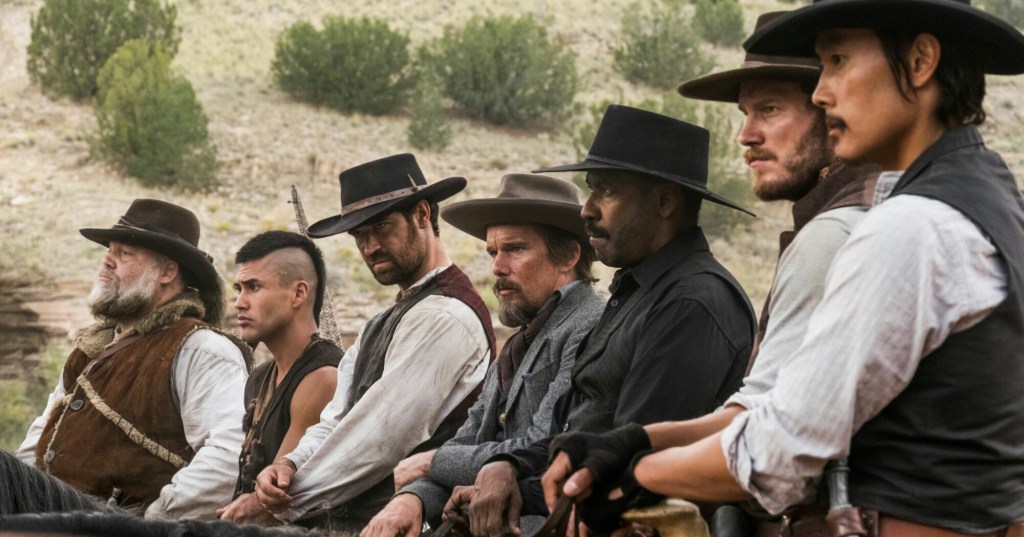
The bare-bone essentials are the same: seven mercenary gunmen protect a town from a ruthless villain and his large army of bandits. That’s pretty much all the two films share in common besides their name. Brenner and company fought for a purpose; the new team fights because they don’t have anything better to do.
Amid the often chaotic frenzy within the film, Washington brings his usual gravitas to the role of bounty hunter Sam Chisholm, leader of the “seven.” Audiences are able to buy into the group coalescing as one as a result of Washington’s stature and presence on screen, commanding the respect of his fellow actors and the audience watching comfortably in their seats.
Chris Pratt is an inspired choice to play the group’s unofficial lieutenant, smart-mouthed playboy gunslinger Josh Faraday. The former funnyman turned action star keeps “The Magnificent Seven” balanced with his wit and charm, offsetting the more deliberate performance from Washington.
Unfortunately, Ethan Hawke’s turn as Civil War sharpshooter Goodnight Robicheaux was criminally underutilized in the film. Hawke has the capability to perform at an incredibly highly level dramatically, but not enough time was spent developing Robicheaux’s wariness to use his weapon.
It’s this sort of character development that Fuqua opts to minimize for the sake of the action sequences, proving the director doesn’t get the point of classic western films like “The Magnificent Seven.” The why characters act the way the do is often as important if not more so than what they do. Fuqua oversimplifies these character nuances, turning them into mere anecdotes in service of explosions. This isn’t to say that “The Magnificent Seven” isn’t a largely entertaining film. It certainly is. It just could have been a lot more.
Among the secondary cast, the film’s best performance comes from veteran character actor Vincent D’Onofrio as rugged mountain-man Jack Horne. Most of the characters in “Magnificent Seven” are pretty bland as individuals and serve mainly to further the action sequences late in the film. D’Onofrio brings a life to Horne with a striking accent and depth of emotion unusual in Fuqua’s movies outside of “Training Day.” Indeed, it’s D’Onofrio’s work that is most reminiscent of the Brenner-McQueen film, where each of the seven are given definitive characters from which to work with.
Peter Sarsgaard delivers an embarrassingly memorable performance as the villainous industrialist Bartholomew Bogue ruthlessly terrorizing the small town. Just shy of mustache twisting, Sarsgaard’s Bogue is a subpar imitation of Daniel Day-Lewis’s Oscar winning performance with a similar character in “There Will Be Blood.” For as strong as many of the heroes in “The Magnificent Seven” are, the film’s villain is equally as weak making for a somewhat underwhelming conclusion.
Director Antoine Fuqua makes the most of a pedestrian screenplay by Nic Pizzolatto and Richard Wenk, combining vintage western landscapes with modern action sequences to provide a largely compelling outcome from what could have been a terrible film. Each scene is vibrant and pops off the screen thanks in large part to cinematographer Mauro Fiore. From a directorial sense, “The Magnificent Seven” is a western film that acts more like a traditional action thriller both to the movie’s credit and hindrance at various times over the course of two hours.
Moviegoers expecting an update on the western classic similar to how the Coen Brothers updated the John Wayne classic “True Grit” may leave disappointed. “The Magnificent Seven” couldn’t be much farther from the film it takes its name from.
But if you’re able to ignore or forget the film’s cinematic heritage, “The Magnificent Seven” is a largely entertaining romp of a western that emulates blockbuster action films in the most satisfying ways. Washington and Pratt deliver a fun time at the cinema worth heading out to theaters for.