
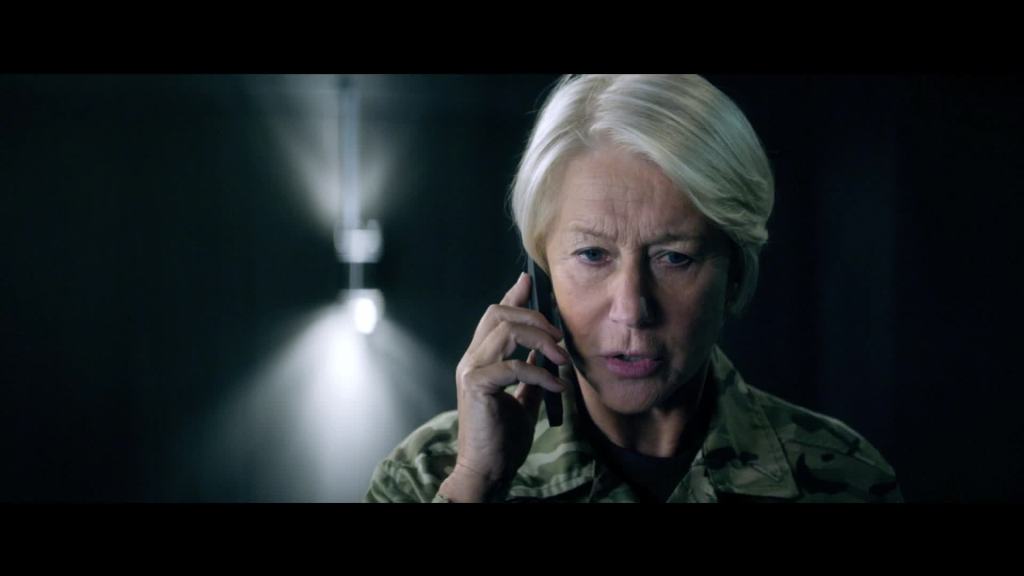
Conflicts in morality and ethical responsibility at the highest levels of government take center stage in the political thriller “Eye in the Sky,” now in wide release.
Oscar winner Helen Mirren headlines an elite cast as a British colonel remotely leading a mission to capture international terrorists in Nairobi, Kenya. When the mission ultimately changes from capture to kill by drone strike, the legal and political stakes gets elevated to extreme levels as a young Kenyan girl unwittingly sells bread on a street corner within the target zone.
Officials from three different nations, military experts, legal minds and spies working on the ground all must make difficult decisions in short order, with “Eye in the Sky” providing gripping drama throughout.
The film works thanks in large part to Mirren’s commanding presence on camera. While the role of military leader isn’t a typical role for her, Mirren blasts through dialogue with ruthless efficiency and insists viewers take notice. This is a rarely seen side of Mirren as an actress and one definitely worth the screen legend exploring further in other films.
Veteran character actor Alan Rickman appears in one of two 2016 films completed before his death in January. His performance as Mirren’s commanding officer is quintessentially Rickman, subtle and profound while simultaneously maximizing his character and not overshadowing his co-stars. An actor’s actor, this film will live on as a reminder of Rickman at his finest, putting the success of a film as a whole above any personal spotlight.
“Breaking Bad” star Aaron Paul plays an important supporting role as the lead American drone pilot in the mission, forced with the constant threat of having to pull the trigger on his first targeted missile strike. Paul’s performance is solid, but not entirely memorable mostly due to the superior work of others in “Eye in the Sky” and not through any fault of his own.
Barkhad Abdi, best known for his Oscar nominated turn as the lead Somali pirate in “Captain Phillips,” gives a strong performance as Jama, a Kenyan national working undercover for the British government tracking the terrorist cell.
Coming off a very showy performance opposite Tom Hanks in his debut film, Abdi proves he can capably maneuver through limited material and develop a layered character with ease. It will be interesting to see if Hollywood is able to cast Abdi in parts that move beyond playing African nationals in war-torn regions. He certainly seems capable of acting outside that realm.
Director Gavin Hood has the difficult task of drawing out and then combining these terrific individual performances from Mirren, Rickman, Paul and Abdi without any two of them ever setting foot in the same room. Hood’s beautiful imagining of Guy Hibbert’s pitch perfect screenplay gives the film vibrancy and tension that probably wouldn’t work nearly as well with lesser talent at the helm.
While the tendency in film is to take controversial topics like drone warfare, surveillance and government red-tape and have the movie advocate one position over another, Hibbert keeps viewers firmly on the fence with “Eye in the Sky.”
There’s a wonderful debate (never fully solved) that questions saving one individual life versus preventing the potential deaths of hundreds. Both sides are ardently argued in the narrative structure of Hibbert’s script, making “Eye in the Sky” a uniquely moderate political film.
Visually, “Eye in the Sky” is more technically sound than a political thriller limited in action and on-screen violence should be. The authenticity and unique camera angles Hood is able to achieve with the film’s drone technology are astounding.
Each next-generation drone featured in “Eye in the Sky” – from the wide scope aerial drone armed with Hellfire missiles to the beetle-sized drone controlled via cell phone – offer innovative ways to capture military drama without ramping up the explosions or gunfire. The film’s worldview where every pull of a trigger is called into ethical question is an ideal situation to employ this incredible technology.
There’s interesting parallels that can be drawn between “Eye in the Sky” and the classic political comedy “Dr. Strangelove,” most notably in the ways that bureaucrats and military leaders endlessly debate every possible situation, collateral damage assessment and moral question all while having their finger on the launch button.
Incredibly relevant to today’s political climate, “Eye in the Sky” is a profoundly compelling political drama and features some of the year’s best performances from Mirren and the late Rickman. Moviegoers who don’t mind a slow-burning, character driven drama would be foolish not to see “Eye in the Sky” as soon as possible.