Tag: JJ Abrams

  • Star Trek Beyond: Boldly going where others have gone before

    Star Trek Beyond: Boldly going where others have gone before

    ​There might not be a more fun movie-going experience this summer than the sci-fi adventure film “Star Trek: Beyond,” which sees Chris Pine return for a third go-round as the iconic Captain James T. Kirk in a role made famous by William Shatner.

    Several years into a deep space mission, the crew of the U.S.S. Enterprise are tasked with rescuing the crew of a wrecked ship on an uncharted planet, until the ship is destroyed by a mysterious villain named Krall (Idris Elba) and most of the Enterprise’s crew is captured. 

    For much of the film, “Star Trek: Beyond” feels more like a fancy television episode with intense and picturesque special effects rather than an elevated theatrical production and the film drags slightly in the middle third as a result.

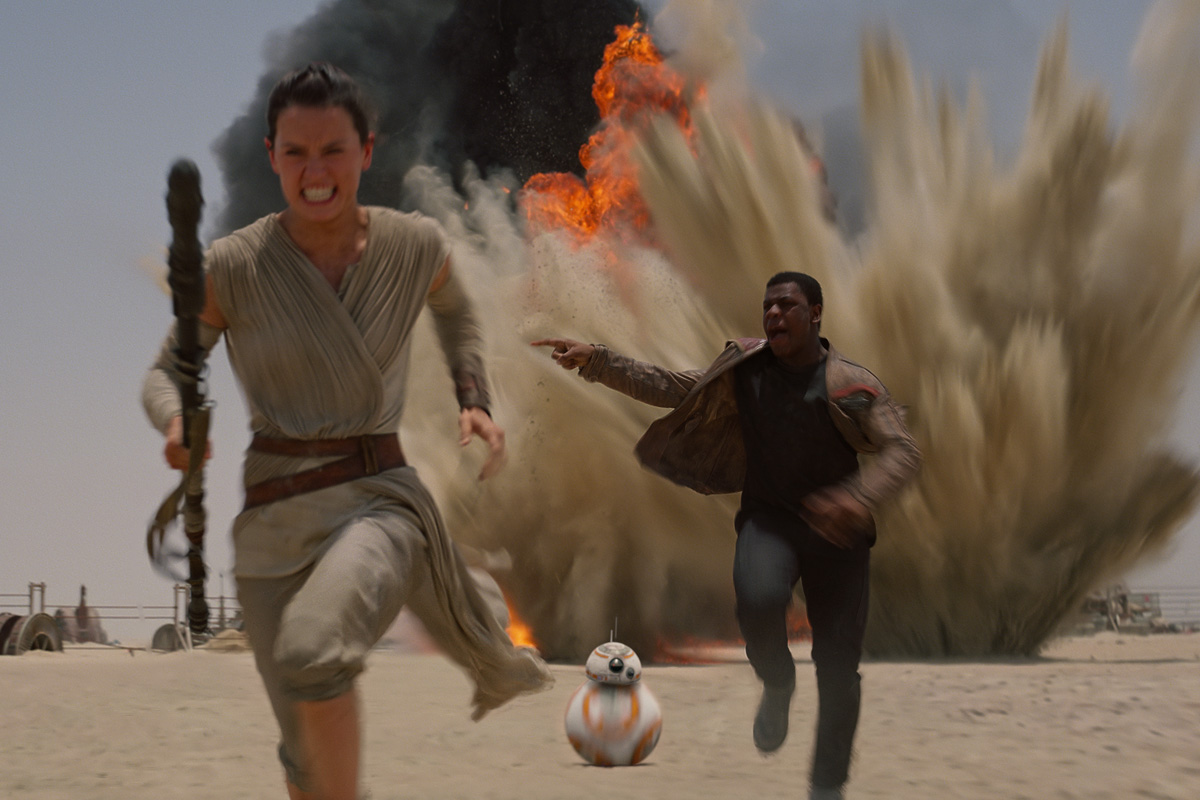
    In reality, the difference between the first two “Star Trek” reboot films and “Beyond” is the difference between “Star Wars: The Force Awakens” and “Fast and Furious 6.” Or in other words, the difference between directors J.J. Abrams and Justin Lin.

    Abrams left the “Star Trek” franchise after two successful installments to breathe life into the next generation of “Star Wars” films, paving the way for blockbuster action director Lin to take the helm.

    Lin’s directorial approach focuses on style over substance and “Beyond” feels incredibly flashy as a result. It should come as no surprise that the best scenes in “Beyond” are the action sequences – Lin’s bread and butter developed over four “Fast and Furious” installments.

    While the “Star Trek” franchise works best as an ensemble piece, Pine has the ideal charisma and cavalier attitude to lead the team as Kirk. “Beyond” doesn’t require Pine to flex his acting muscles very much, but he finds a way to maintain the pretty refined character developed over two prior films without getting in his own way too much.

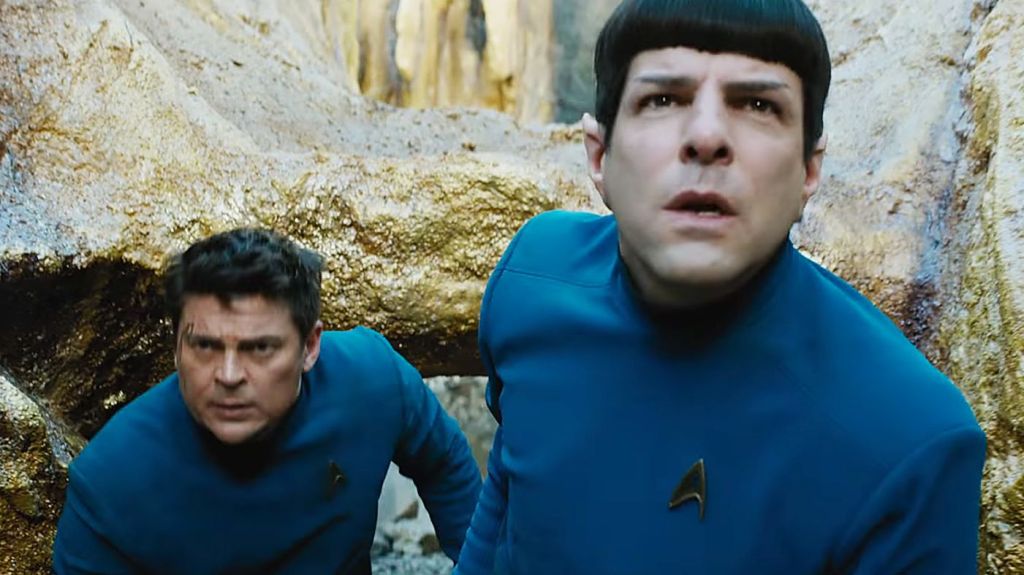
    The real stars of the show are Zachary Quinto and Karl Urban in their love-hate relationship as first mate Spock and medical officer ‘Bones’ McCoy. The film’s script co-written by star Simon Pegg, who plays engineering chief Scott, peaks in scenes between Spock and McCoy. The unlikely pairing makes for some of the film’s funniest moments as well as most of its best dramatic ones as well.

    The reboot “Star Trek” films have been defined, in part, based on strong performances from veteran character actors in the main villain role. Following Eric Bana and Benedict Cumberbatch, Elba is a fantastic choice to play the nefarious warlord Krall, though it’s unclear whether Lin knows exactly what to do with him.

    Elba is nearly unrecognizable as Krall buried under mounds of makeup, which limits his ability to emote using facial expressions and takes away a key part of Elba’s acting arsenal. Given the bland way in which his character is written, Elba does a solid, yet unmemorable job as the baddie with a grudge to settle.

    “Beyond” also features a touching homage to Leonard Nimoy, the original Spock, who passed away following his final turn in the role in “Star Trek: Into Darkness.” It’s fair to expect a similar homage to Anton Yelchin, who died in a car accident shortly after filming his scenes as Chekov in “Beyond.” 

    The film also has a much lighter, family friendly tone both in cinematography and storytelling than the brutal previous installment “Star Trek: Into Darkness.” Though it sits firmly in the PG-13 rating category, the third “Star Trek” film is a much more inviting film for younger audiences unfamiliar with the franchise’s rich television and film history.

    “Beyond” is a more than worthy entry into the “Star Trek” film franchise canon and without a doubt the most exciting summer blockbuster film so far this year. While it doesn’t quite have the same substance as the other two reboot entries, “Star Trek: Beyond” has more than enough style to keep the Enterprise’s engines running for quite some time.
  • 10 Cloverfield Lane: Claustrophobia inducer a surprise hit

    10 Cloverfield Lane: Claustrophobia inducer a surprise hit

    Eight years ago, a surprise hit film came out of nowhere to wow viewers with its unique found-footage style adaptation of the classic monster movie genre.

    The film, “Cloverfield,” had a grandiose, epic feeling that pervaded the movie from start to finish, while new release “10 Cloverfield Lane” – dubbed a “blood relative” to the 2008 monster movie by producer J.J. Abrams – couldn’t be farther from its spiritual sibling.

    Confined to small, terror-inducing spaces deep underground, “10 Cloverfield Lane” is a cinematic master course in paranoia, evoking the best elements of a “Twilight Zone” episode and Alfred Hitchcock’s “Rear Window” at the thriller’s high points.

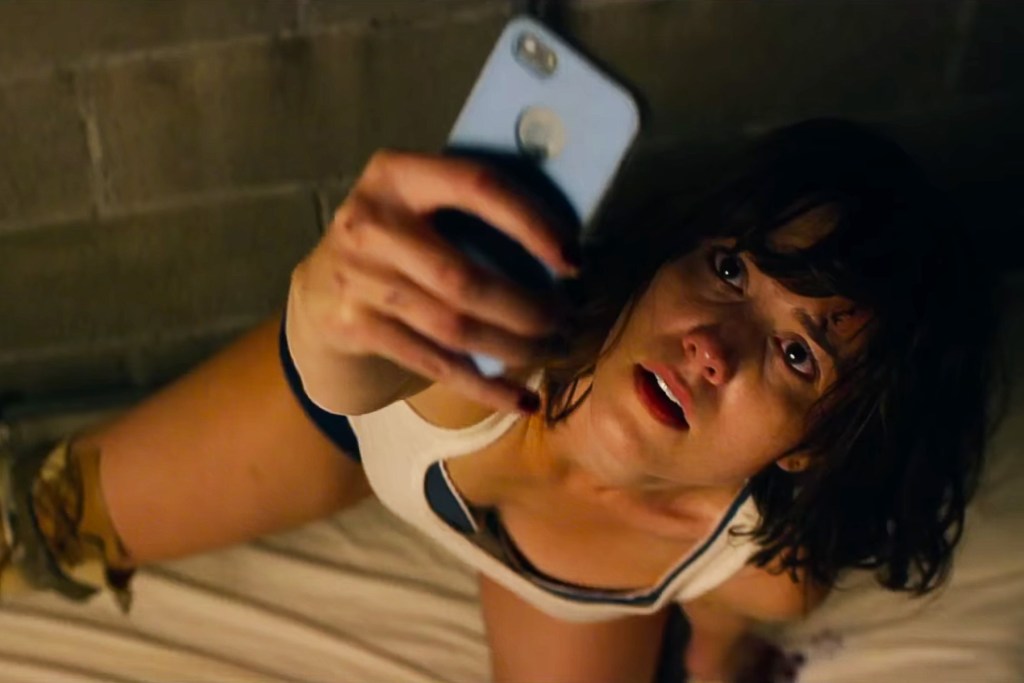
    Indie darling Mary Elizabeth Winstead stars as Michelle, a woman who awakes from a car accident chained to a wall in an unknown location. Her captor Howard, played by a mesmerizing John Goodman, believes he has saved her from the impending apocalypse by hiding in an emergency bunker outside his rural farm house.

    What ensues is about 80 minutes of a scintillating dramatic thriller with Michelle and fellow captive Emmet attempt to figure out whether Howard is friend or foe and more importantly, whether or not the world is ending.

    It’s important for viewers to know as little as possible heading into “10 Cloverfield Lane” and watching 2008’s “Cloverfield” doesn’t affect the viewing experience either way. The two films, aside from name alone, are polar opposites visually and structurally, with the new “Cloverfield” incarnation ultimately being a much better film overall.

    A mainstay on the indie film circuit, “10 Cloverfield Lane” could represent a breakout moment for Winstead, whose Michelle is incredibly easy to get behind as a viewer. These seemingly generic “damsel in distress” roles can be easily overplayed and become caricatures, but Winstead effortlessly provides Michelle with a level of authenticity not typically found in either the thriller or horror genres that “10 Cloverfield Lane” toes the line between.

    While not on the same level as Brie Larson’s more showy Oscar-winning performance as a woman in captivity in last year’s “Room,” Winstead gives the film a proper balance and keeps “10 Cloverfield Lane” from being too much about Goodman’s stellar supporting work or the film’s looming (and largely disappointing) end.

    Annual award shows typically never recognize quality cinematic work in psychological thrillers and despite a nomination-worthy supporting performance, Goodman won’t get the recognition he deserves as Howard. The veteran character actor layers Howard with equally convincing moments viewers will believe he is either sinner or saint, Michelle’s captor or her savior.

    A performance like this has always seemed to be right at Goodman’s fingertips, though he’s never been as captivating in bigger films like “Argo” or “O Brother, Where Art Thou?” as he is in “10 Cloverfield Lane.” Director Dan Trachtenberg’s choice to use extreme tight shots, closing viewers into confined spaces, helps make Goodman’s domineering size and powerful performance all the more intense.

    While “10 Cloverfield Lane” is primarily a two-handed film between Winstead and Goodman, John Gallagher Jr. offers a compelling supporting performance as fellow captive Emmet and Oscar nominee Bradley Cooper has a small, voice-over cameo as Michelle’s boyfriend.

    The film only falters in its final moments, when it largely abandons the visual and narrative structure Trachtenberg has created for a poorly sequenced, generic ending more befitting a second-rate horror movie. The insistence on tying this “spiritual sequel” back to its predecessor in name alone totally changes the entire tenor of the film, and not for the better.

    Visually, Trachtenberg creates a dynamic environment for Goodman and Winstead to play in, keeping the pressure on from moment to moment thanks to gripping close-up shots and expertly lit spaces. The film’s cinematic homage to “Die Hard” with Winstead crawling through air vents like Bruce Willis was an especially welcome touch.

    “10 Cloverfield Lane” ultimately suffers from being 10 minutes too long, with the claustrophobia-inducing film on track to be one of the year’s best films only to shoot itself in the foot at the very last second.

    Though almost nothing like its cinematic relative “Cloverfield,” “10 Cloverfield Lane” is worth a trip to theaters if for no other reason to experience Winstead and Goodman verbally duke it out in close quarters.

  • Star Wars The Force Awakens: Episode VII fulfills legacy of original trilogy

    Star Wars The Force Awakens: Episode VII fulfills legacy of original trilogy

    Heading in to the seventh installment in the famed science fiction franchise, it seemed almost certain that “Star Wars: The Force Awakens” – which opened Thursday evening – would either bomb or blow viewers away. There didn’t really seem to be an in-between.

    Fans were right to be cautiously optimistic about the first true sequel in the series after being let down when a much-hyped “Star Wars Episode I: The Phantom Menace” debuted to less than glowing reviews from both critics and die-hards alike in 1999. Two subsequent prequels – “Attack of the Clones” and “Revenge of the Sith” – fared better, but neither felt up to par with the original trilogy.

    Sixteen years later, “The Force Awakens” fulfills the promise of what “The Phantom Menace” could have been – a true space adventure that takes advantage of modern technology filled with everything fans decked out in Jedi robes and Stormtrooper costumes lining up outside theaters hours in advance of the first showing had hoped for.

    Visually, the film is the best entry in the entire catalog of “Star Wars” installments, which should surprise no one. While the action sequences don’t quite rise to “The Empire Strikes Back” level of enjoyment in storytelling, combat on the ground and in the skies is more compelling than it probably ought to be thanks in large part to director J.J. Abrams layering of smaller moments to create tension and character development throughout each sequence.

    What sets “The Force Awakens” apart from the rest of the franchise, even more so than the spectacular cinematography and effects, are the talented cast members added to the “Star Wars” universe in the seventh episode of the series.

    Perhaps the biggest flaw of the “Star Wars” prequel trilogy was poor acting from major characters in the film, most notably Hayden Christensen’s stiff, lifeless portrayal of a pre-Darth Vader Anakin Skywalker. That, coupled with a largely racist caricature akin to the crows of “Dumbo” in Jar Jar Binks and subpar screenwriting, led to a disappointing series that hardcore fans either force themselves to watch or ignore completely.

    Abrams, coming off a widely successful turn rebooting the “Star Trek” franchise, hits the mark with three “Force Awakens” cast members brand new to the
    “Star Wars” series.

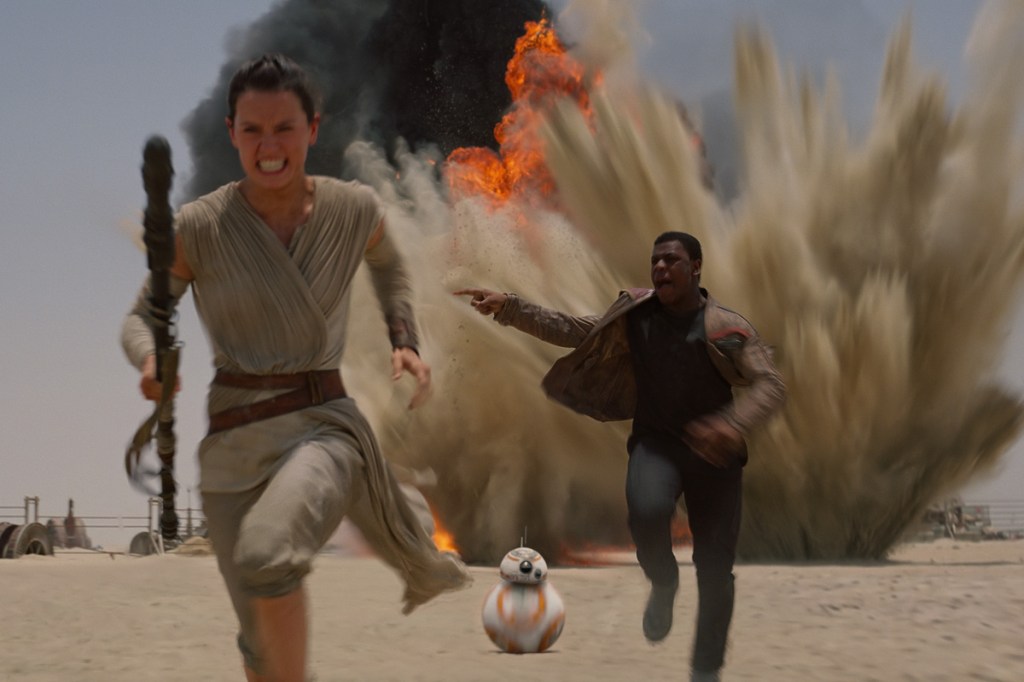
    John Boyega offers up the series’ most emotionally conflicted performance as a young Stormtrooper struggling to perform his duties in service to an evil new alliance. Unknown to American audiences with a cult British film under his belt, Boyega could easily prove to be the new face of the “Star Wars” franchise in much the same way Mark Hamill was 30 years ago.

    image

    The film’s true star, Daisy Ridley, is a revelation as Rey, a young scavenger on Jakku who gets thrust into a pivotal role in yet another civil war by happenstance. Her performance is more layered and effective than either Natalie Portman’s Padme Amidala in the prequel trilogy or Carrie Fisher’s iconic, yet one-note turn as Princess Leia in the original trilogy.

    While it’s still early in her career, “The Force Awakens” could be the star making action vehicle for Ridley that “The Hunger Games” was for Academy Award winner Jennifer Lawrence. Female characters have largely been underdeveloped caricatures in the science fiction genre, though Ridley absolutely nails the mold-breaking character of Rey. Leaning the future of the “Star Wars” franchise on her shoulders wouldn’t be the worst way to move the series forward.

    The most famous of Abrams’ three new stars, Oscar Isaac of the critically acclaimed “Ex Machina” and “A Most Violent Year,” actually has the least to do in the film as the Rebellion’s best pilot. His role as Poe Dameron feels more like a teaser for a much bigger part in future installments and while Isaac is one of the best character actors around, there isn’t much room for him to show off his stuff.

    Shorting Isaac screen time was probably for the best as it saves room for extended sequences featuring screen legend Harrison Ford as his iconic rebel without a cause, Han Solo, and Peter Mayhew as the formidable Chewbacca. Ford’s return is especially memorable and while not necessarily on par from an acting perspective, his fourth turn as Solo is as crucial to making “The Force Awakens” work as a film as Sylvester Stallone as Rocky Balboa in “Creed.”

    The only true flaw within the latest “Star Wars” adventure lies in its clunky, derivative screenplay, which at times feels more like a remake of the 1978 original film than a new adventure. The disappearance and later return of one major character with only a cursory explanation feels like an afterthought rather than true decision making about how to utilize the part.

    While advances have been made in almost all aspects, the seventh episode’s script is almost comically formulaic, as if screenwriters Lawrence Kasdan, Michael Arndt and Abrams copied previous entries in the “Star Wars” franchise and copy-pasted new character names and dialogue over a template plot structure.

    A major twist in the plot revealed to viewers two-thirds through the film could have completely ruined a lesser version of “Force Awakens,” but Abrams handles the rest of the film with such care and aplomb that the impact of the franchise altering twist will be sustainable in the long term. Having talented new actors to carry the torch forward certainly helps.

    As a standalone movie, “Star Wars: The Force Awakens” is solidly one of 2015’s five best films, on par with George Miller’s post-apocalyptic masterpiece “Mad Max: Fury Road” and just a step or two below Ridley Scott’s “The Martian.”

    In the context of the “Star Wars” franchise, “The Force Awakens” far exceeds the trilogy from the late 1990s and early 2000s and serves as the true return for cinema’s premiere space adventure series.

    Oftentimes as fans, we build up in our heads what another film continuing the stories of our favorite movies might look like, who we’d cast in it, what would happen and how awesome that would be if filmmakers could pull the movies we have in our minds out of our heads and onto the big screen for all to enjoy.

    Normally, when those films actually come out, we end up having to say, “Well, it wasn’t as good as what I thought it’d be.”

    Don’t worry. You’re not going to be saying that about “The Force Awakens,” as both Jedi and Sith alike can rejoice that the newest “Star Wars” film gives them everything they were hoping for and more.