Unwavering heroism amidst the ravages of war is explored in Mel Gibson’s latest directorial effort “Hacksaw Ridge,” sure to be one of the year’s ten best feature films.
Gibson expertly combines gruesome World War II era violence akin to Steven Spielberg’s classic “Saving Private Ryan” with dramatic underpinnings of faith, family and love for your fellow man that one might expect in a traditional faith-based movie.
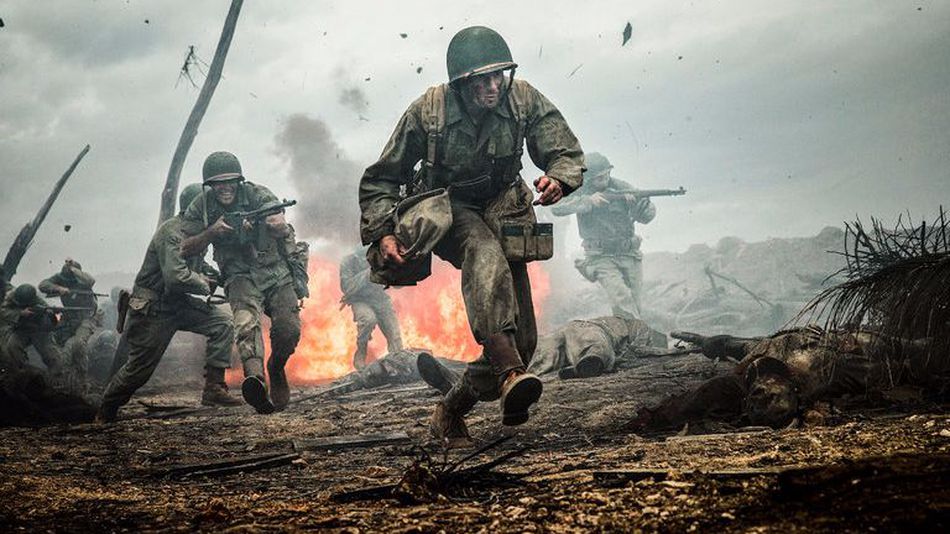
“Hacksaw Ridge” tells the true story of Desmond Doss, a Seventh Day Adventist who volunteers to serve in the Pacific during World War II despite being a conscientious objector who refuses to carry a weapon into battle. Doss overcame court-martial to serve his country at the Hacksaw Ridge offensive during the Battle of Okinawa, rescuing 75 men as a combat medic largely behind enemy lines.
Andrew Garfield shines as Doss, a man imbued with unshakeable conviction for both his country and his nonviolent beliefs. “Hacksaw Ridge” is unquestionably the best work of Garfield’s career and, along with a stellar turn in last year’s “99 Homes,” marks a turning point past two films in the “Spiderman” franchise. While it could be easily said that “Hacksaw Ridge” is an incredible war film, Garfield’s expert portrayal of a man who refuses to fight but demands to serve elevates the performances of every actor around him and the movie as a whole.
Hugo Weaving, who has largely slept-walked his way through films since his breakout as Agent Smith in “The Matrix” trilogy, comes alive opposite Garfield as Doss’s alcoholic, belligerent father racked with emotional guilt after being the only of his friends to survive two tours of duty during World War I. Many war films attempt to gloss over the home life of the soldiers they feature, but Gibson embraces the task head-on in limited, but well-acted scenes between Weaving and Garfield. Both actors perform flawlessly in developing the character of the man Doss was by hammering home how he came to be that man.
Less successful in this respect is the film’s romantic interludes as Doss courts a local nurse named Dorothy (Teresa Palmer) who later becomes his wife. At first glance, it’s unclear whether the romance angle of “Hacksaw Ridge” falters due to script issues or Palmer’s bland, ineffective performance, but the on-screen couple have very little chemistry.
Doss’s military superiors as played by “Avatar” star Sam Worthington and funnyman Vince Vaughn are unusual casting choices, but neither actor gets in the way of the overall film.
“Hacksaw Ridge” is perhaps the most graphically violent World War II era war film since “Saving Private Ryan,” but Gibson relies on the authenticity of the conflict to drive home just how harrowing Doss’s story of heroism and survival genuinely was. With the lead character serving as a medic, it shouldn’t come as much surprise that the level of gore within “Hacksaw Ridge” is amplified by the length of time bodies with severed limbs are shown on screen.
Embracing violence has been a trademark of his films dating back to 1995’s “Braveheart,” but Gibson does a terrific job of approaching the ravages of war from a fresh perspective and is buoyed by Garfield’s strong individual effort. “Hacksaw Ridge” will likely stay in the Oscar conversation, but ultimately fall short due to the graphic violence and controversial nature of the film’s director. It would not be a surprise, however, to see Garfield’s work in the film honored as part of a nomination for his role in Martin Scorcese’s “Silence.”
Doss’s tale of patriotic heroism is too important for mature audiences not to make an effort to see “Hacksaw Ridge” at least once and Gibson’s film will probably never look better than it does on the big screen. Even though it arrives in a highly charged political climate, the film opts to avoid definitely becoming a pro-war or anti-war piece and benefits greatly from its relative evenhandedness.
While not a perfect film, “Hacksaw Ridge” will ultimately be remembered as one of Hollywood’s best World War II efforts and a must see for those capable of handling its brutality.