
Year: 2022

  • The Tender Bar: Uneven family drama

    The Tender Bar: Uneven family drama

    Slice of life Americana films only truly work about once in every six or seven attempts.

    Most of the time, these period-driven, small town family dramas attempt to bite off more than they can chew by introducing more characters than they can give adequate time to or by muddling the narrative with time jumps or by simply being bland.

    All these things, unfortunately, are true of George Clooney’s latest directorial effort, The Tender Bar, recently released in theaters and now streaming on Amazon Prime.

    Based on the memoir by Pulitzer Prize winner J.R. Moehringer, The Tender Bar follows a young boy with an absentee father growing up on Long Island in search of male role models and finding wisdom in his uncle’s tavern.

    Writer William Monahan, most notable for his screenplay for Oscar winner The Departed, provides Clooney with a wildly uneven script that has some terrific individual moments between a young JR and his uncle but languishes for far too long on JR’s college years without providing enough emotional connection to his youth.

    The result is an often tedious melodrama that leans heavy on the hard luck story of Moehringer’s youth much like last year’s Hillbilly Elegy, a big-budget, R-rated version of a Hallmark movie that fails to pay off emotionally in the end and will leave some viewers bored.

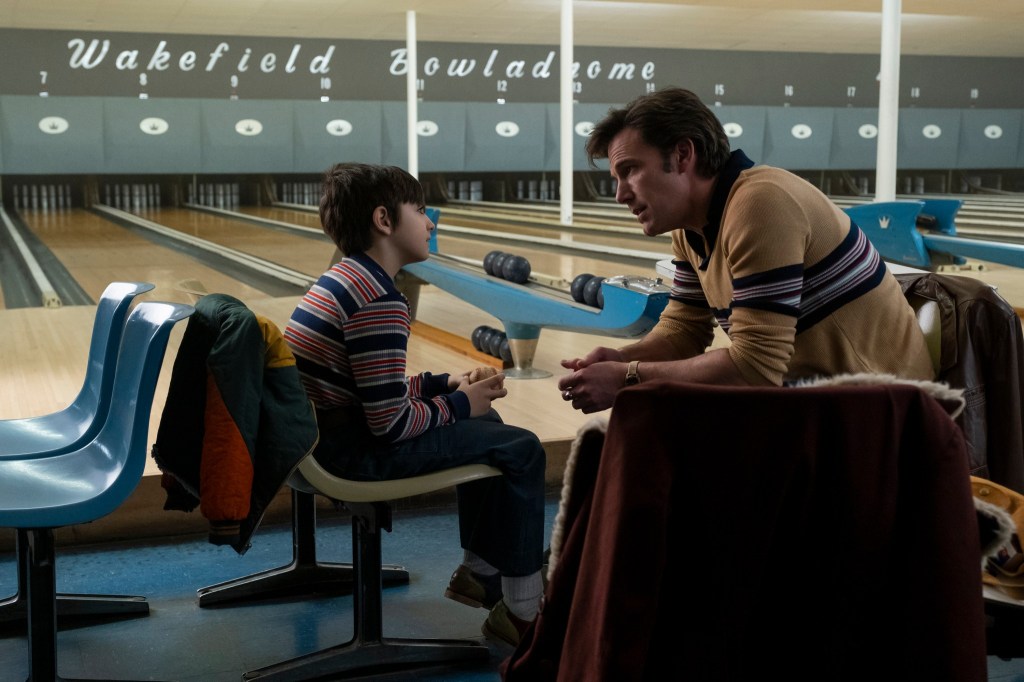
    By far the most compelling performance in the entire film, Ben Affleck shows incredible depth of heart behind a mostly stern and solemn face as JR’s uncle Charlie. Affleck is given the best lines in Monahan’s screenplay and delivers them with an unspoken compassion that radiates off the screen and allows audiences someone to bond with emotionally.

    He does a fantastic job introducing audiences to first-time actor Daniel Ranieri, who plays a nine-year-old JR with wide, inquisitive eyes and with a vast admiration for his uncle Charlie. Conversations between Ranieri and Affleck have genuine affection that leave viewers wanting more from the relationship than what Clooney and Monahan are willing to offer.

    Lily Rabe does a capable job of playing JR’s mother throughout, but with limited character development and Monahan largely sidelining her to highlight Charlie, there’s not much beyond a surface level examination of any of the women in JR’s life. His grandmother largely serves as a stand-in background character and audiences never truly get a picture of why JR becomes obsessed with his college girlfriend.

    Ty Sheridan plays the collegiate JR well, but the whole older JR experience is so clumsily written and staged that it’s impossible to separate his performance from the poor craftsmanship around it.

    There’s almost entirely no need for a voiceover in The Tender Bar, though Clooney and Monahan feel compelled to push one into the narrative randomly to help provide context that it appears they couldn’t put into the actual film through character work or an additional scene.

    Even though Ron Livingston’s cadence keeps in tone with the overall narrative, his presence simply cheapens the entire film and somewhat jars audiences the first time Livingston narrates.

    There are some sharp visuals at times from cinematographer Martin Ruhe and the score from composer Dara Taylor does well to round out some more compelling moments.

    Affleck received a Golden Globe nomination for best supporting actor for his work on the film, but it’s highly unlikely that it will translate to an Oscar nomination despite being the only real shot for The Tender Bar to receive acclaim from The Academy.

    The family-driven melodrama shouldn’t be anything potential viewers rush out to theaters to see, but the ease of access through Amazon Prime and exceptional work from Affleck in a large supporting role make The Tender Bar a mild, yet tepid recommendation.
  • Don’t Look Up: Stop worrying and love the comet

    Don’t Look Up: Stop worrying and love the comet

    Stanley Kubrick made Dr. Strangelove, a quintessential black comedy of the 1960s starring Peter Sellers as a treatise against the uneasy relationship between America and Russia’s nuclear arms race.

    It’s one of the driest modern comedic films with a biting screenplay and pitch-perfect acting that fully realizes its auteur’s vision and works on numerous levels for casual as well as fully engaged audiences.

    Adam McKay, the filmmaker behind several of this generation’s most beloved comedies, must be a huge fan of Kubrick’s seminal classic, as his latest feature takes a similar approach to modern politics and the public’s relative disinterest in the possibility for natural global catastrophes.

    Don’t Look Up is the third in a series of sardonic, topical films from McKay and his first collaboration with Netflix, an overly stylized movie that aims to be far cleverer than it actually is and misses the mark about half the time as the comedian strives to make too many social and political points.

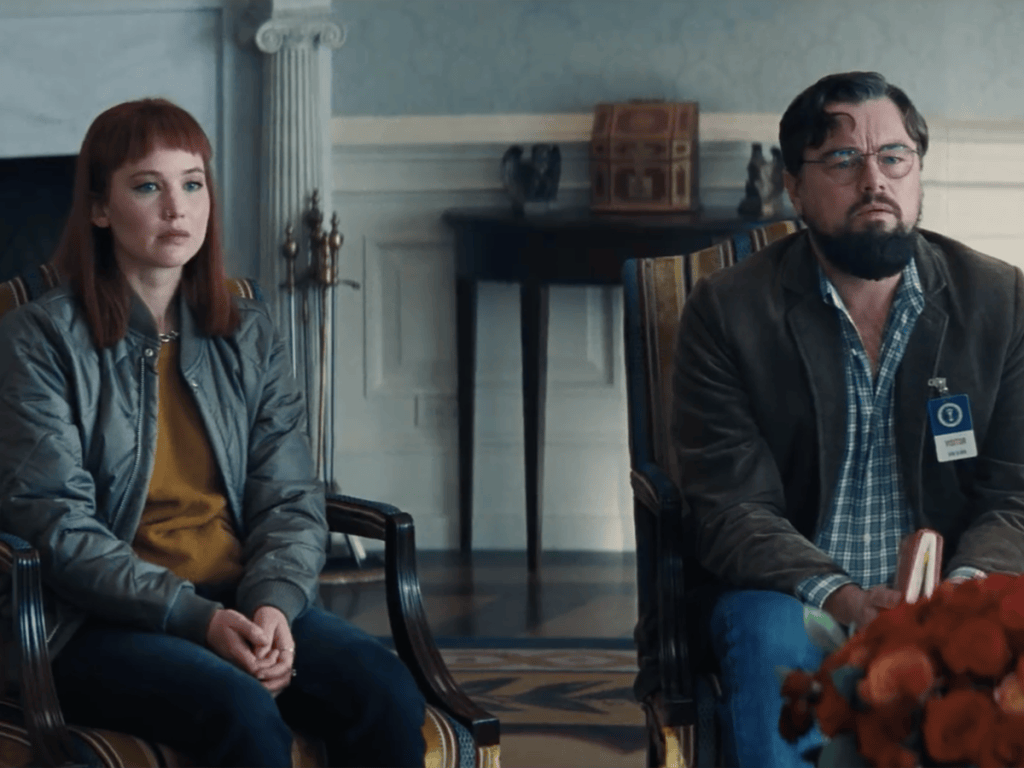
    Oscar winners Leonardo DiCaprio and Jennifer Lawrence star as a pair of Michigan State University scientists who discover a massive comet on a direct collision course with planet Earth that will wipe out all civilization. Although this is the basic premise behind disaster films like Armageddon and Deep Impact, McKay’s film takes a much calmer, more esoteric approach more in keeping with Kubrick’s passive-aggressive approach to message-based storytelling in Strangelove.

    Lawrence makes her cinematic return after several years off with her trademark sarcasm cranked up to an 11. The Academy Award winner relishes every opportunity to sink her teeth into cutting remarks written by McKay that seem targeted at other characters in the film but are truly meant for audience members at home to reflect on their own world view.

    By contrast, DiCaprio has the more mellow of the two lead performances, if such a thing is possible and masks his natural charm and good looks behind poor hair and shoddy glasses to allow a quiet, nuanced character to emerge. His Randall suffers from several psychological maladies from anxiety to depression that give DiCaprio a wide berth from which to play his most skittish role and often the most amusing character on screen.

    The film boasts an impressive ensemble cast with Tyler Perry and Cate Blanchett being the perfect foils for DiCaprio as a morning talk-show team that challenges his morality and sanity in a Network-esque fashion, while Meryl Streep and Jonah Hill are more frustratingly over-the-top as the inept president and her son, the chief of staff, meant to exaggerate the trivialities of the Trump administration.

    McKay actually has an impressive screenplay that is more sardonic and cutting than either of his Oscar-nominated films The Big Short and Vice. But as a director, he fails to bring his own writing to life consistently by keeping audiences out of the joke for far too long at moments and being overly ambitious in the editing room.

    Don’t Look Up jumps back and forth between scenes at a rapid-fire pace in an attempt to jar audiences awake to the messages McKay espouses in his narrative, but he goes to this well far too often so that it becomes messy and unnecessarily convoluted. 

    A big swing from an award-contending director with the most star-studded cast this season, Don’t Look Up likely won’t receive the accolades that Netflix might have hoped for when the studio acquired the project from Paramount Pictures and spent $75 million to make the film. There’s too much talent involved to completely count the picture out of races, but it’s unlikely that Netflix will push too hard with the more well-received drama The Power of the Dog also in the fold for the streamer.

    McKay’s film has a lot of individual moments that make Don’t Look Up a terrific black comedy warning about political and social divisiveness in a way that reflects Strangelove. But it’s terribly inconsistent in both its comedy and narrative structure, which makes the feature a frustrating film to watch.