Author: Matt Ward

  • Uncharted: International treasure

    Uncharted: International treasure

    Almost by definition, films based on video games are subpar features meant to propel teenagers into buying the latest installment in the entertainment franchise on PlayStation, Xbox, or computer console.

    Movie franchises have spawned from several popular titles over the years including multiple Tomb Raider installments, fighting series like Mortal Kombat and Street Fighter, as well as a Resident Evil series.

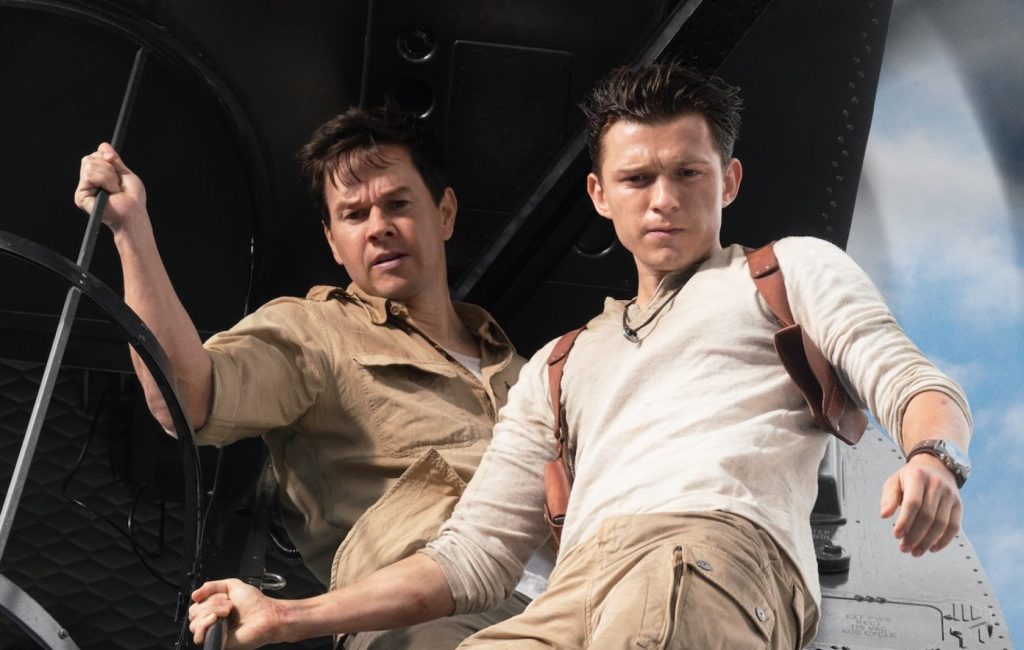
    In recent years, PlayStation has been the most aggressive in attempting to develop its original content with several planned films and television series in the works. The first of which, Uncharted, starring Tom Holland and Mark Wahlberg, debuted this past weekend after being twice delayed in 2021 due to the COVID-19 pandemic.

    Based on the action-adventure gaming franchise of the same name, Uncharted follows a young Nathan Drake as he is lured into a high-stakes quest for the long-lost treasure of world traveler Ferdinand Magellan by a fortune hunter who worked with Nathan’s missing brother Sam.

    Perhaps the biggest flaw of director Ruben Fleischer’s film is Holland himself, who gives a charismatic performance as Nathan, but sounds and acts too much like his now iconic Spider-Man character to be fully believable here as a naïve treasure hunter. The young British actor pulls off his American accent quite well, and yet ardent Marvel fans will hear and see Peter Parker on the screen.

    This especially occurs during the film’s numerous stunt pieces, which often require Holland to perform some sort of parkour leap or long swing that one might expect from a certain comic book webslinger. And while it’s to be sure that Fleischer is ramping up the dynamics of these sequences to give the video game aesthetic, Holland might not the perfect choice.

    Wahlberg fares somewhat better as fortune hunter and erstwhile mentor Sully as his charisma and surly Boston personality makes him a solid antihero with just enough questionable motivations to create dramatic tension with Nathan.

    The best performance in the film is given by Antonio Banderas, playing slightly against type as the heir to a global financier family with claims to the Magellan gold. It’s a welcome sight to see Banderas play someone this ruthless and the gravitas and edge he brings to the role makes for a formidable and logical foe in a film where logic is somewhat lax.

    For an action-adventure movie, Uncharted has a lot of turn-your-brain-off style entertainment that can be a lot of fun in bursts, especially a cargo plane sequence ripped directly from one of the video games that sets the tone for both the first and third acts of the film.

    Visually, Uncharted has some beautiful sequences that feel like the cinematic cut-scenes one might find in the video games and the exotic locations are treated as truly unique and special. 

    Fleischer doesn’t always find the right tone throughout as the film becomes a mixed bag of everything from National Treasure to Angels and Demons to the Tomb Raider movies without defining itself separately.

    In spite of all of its many flaws, moviegoers desperate for a little bit of mindless fun and willing to go with the incredulous nature of the plot may find Uncharted worth taking a chance on in theaters.
  • Marry Me: The simplest of proposals

    Marry Me: The simplest of proposals

    Sometimes the best performances an actor can deliver on screen are the ones that closely mirror who they are in real life.

    They could be portraying another actor and draw from their own personal experiences to get into the right state of mind or perhaps they have gone through similar struggles and find that the best way to connect to the character.

    And yet, in some instances, a character can be written in such a way that it just feels like the actor portraying them is just being 100 percent themselves just with a fake name and made-up storyline.

    Marry Me, the latest romantic comedy to arrive in theaters as well as streaming on Peacock, essentially asks the question, “What if Jennifer Lopez randomly proposed to an average nice guy on the street and brought him into the world of superstardom?”

    Director Kat Coiro’s major feature film debut evokes the classic Julia Roberts rom-com Notting Hill but without the same amount of heartfelt laughter and emotion.

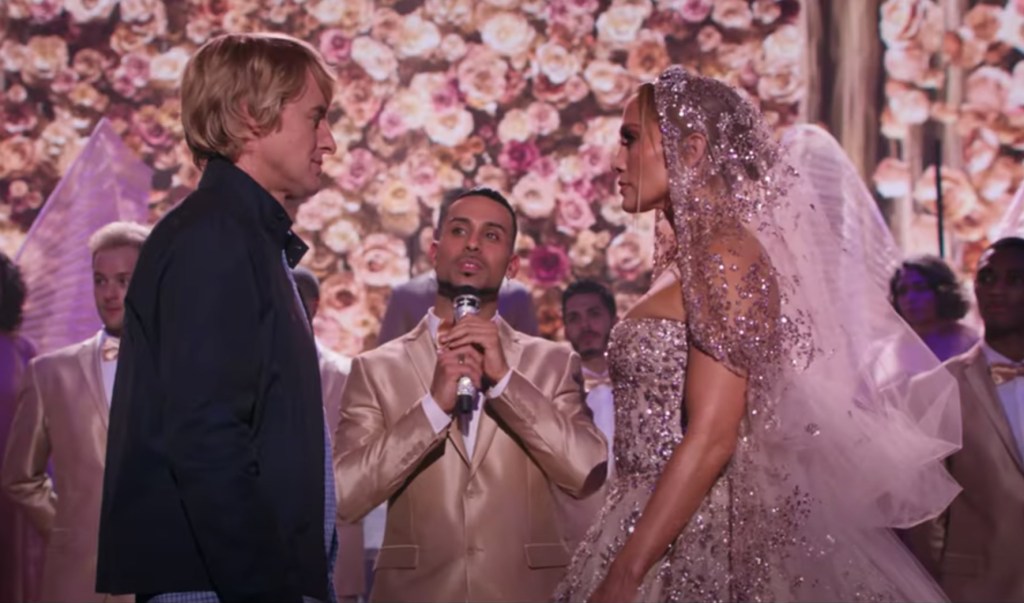
    When pop superstar Kat Valdez finds out her fiancé is cheating on her seconds before a live televised wedding, she spontaneously opts to marry Charlie, a stranger in the crowd, instead.

    Lopez plays a heightened version of herself as Kat in a performance that’s slightly naïve to the world around her and just wants to make genuine connections with the people in her life.

    Her chemistry with the dorky, yet charming Owen Wilson can be a tad hit-or-miss, but where Lopez truly shines in Marry Me are in the film’s numerous musical moments. Backed by a soundtrack she created, it often feels like Lopez is shooting a music video with dazzling wardrobe, a cavalcade of dancers and a flashy, constantly moving camera.

    When Marry Me is at its most entertaining, it’s Kat walking down a flight of stairs in a million-dollar ballgown while belting a ballad or a montage of Kat and Charlie’s lives being changed by the other while Kat records the song playing in the background. It’s the Lopez show from start to finish.

    Wilson, on the other hand, is as understated as he can be as the everyday man that he’s played in film after film after film. His chemistry with Lopez isn’t exactly ideal but works in the context of this romantic comedy as it doesn’t really matter how connected Wilson and Lopez actually are. He is effective on his own, especially as a sympathetic teacher. In a larger context, however, it’s clear Wilson is not on the same page as Lopez in the overall scheme of Marry Me.

    Among the supporting players, none is better than comedienne Sarah Silverman as Wilson’s coworker and guidance counselor who just happens to be LGBTQ+ to keep her from being a better match than Lopez. Silverman delivers the comedy from start to finish and is largely responsible for much of the laughs of Marry Me as well as the impetus of the film’s plotline as well.

    Written by four screenwriters, the overall plot of Marry Me is so incredulous that It makes the traditional romantic comedy seem bland by comparison, but Lopez and Wilson make the script work in their favor to create a largely enjoyable film.

    While it isn’t the kind of movie that would be recommended to travel to the theaters to see, the fact that it is equally accessible on the Peacock streaming service makes Marry Me worth a mild recommendation for moviegoers to seek out if they already have the streaming service.

  • Nightmare Alley: Beautiful noir for small crowd

    Nightmare Alley: Beautiful noir for small crowd

    Acclaimed auteur Guillermo del Toro hasn’t made a new film since winning both best director and best picture in 2018 for his eccentric feature The Shape of Water.

    del Toro is known as a master of the avantgarde, relishing in the eccentricities of life and the oddities of horror for decades with everything from Pan’s Labyrinth to a pair of Hellboy films to an upcoming adaptation of Pinocchio for Netflix.

    His latest film, Nightmare Alley, taps into del Toro’s love for the obscure and bizarre, all the while emphasizing the uniqueness of a period piece that twists and bends what the mind might find conceivable.

    Based on both the 1946 novel and 1947 film of the same name, Nightmare Alley follows Stanton Carlisle, a man who joins the circus leading up to World War II after murdering a man and burning down his house. When he learns the art of mentalism from a “clairvoyant” couple, he sets off on his own for fortune that ultimately leads down a dark path. 

    Bradley Cooper provides a mostly stoic yet measured performance as Stanton and it’s a turn that helps ground the audience in the story without endearing them too much to his questionable choices. 

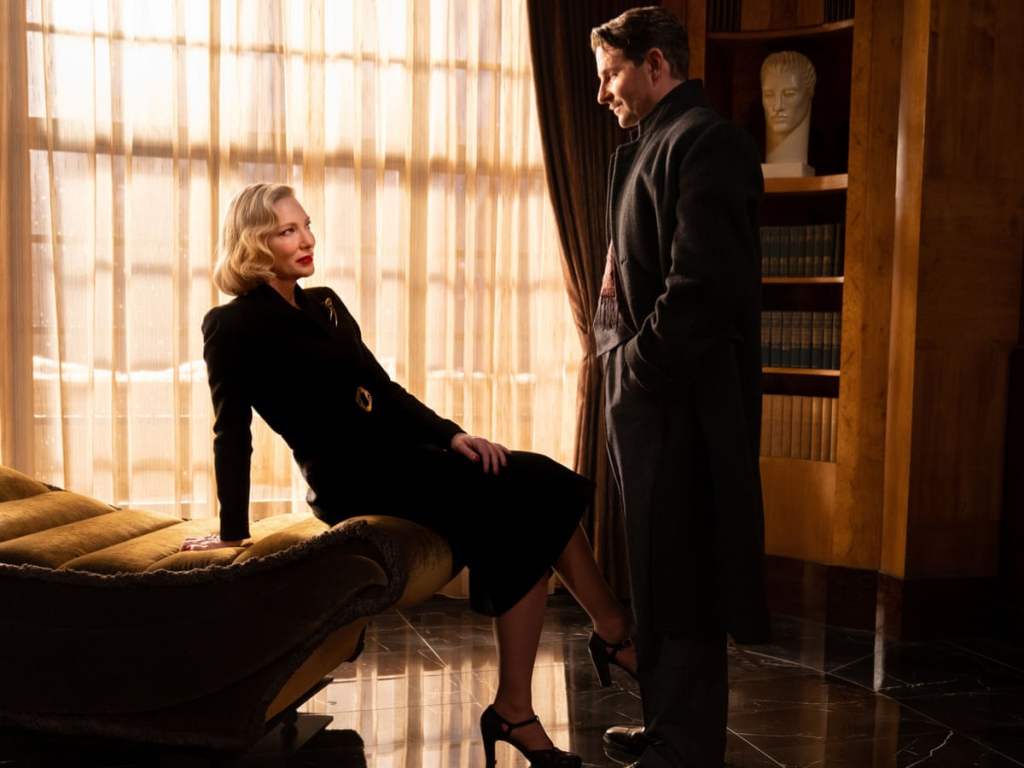
    While his chemistry with Rooney Mara’s Molly is somewhat shaky despite the plot’s desire to pair them, his ability to match Cate Blanchett’s mysteriously alluring Dr. Ritter makes for a scintillating repartee that anchors the back half of the film. 

    Nightmare Alley has an incredibly deep and talented supporting cast from David Strathairn and Toni Collette’s masterful work as the clairvoyants to Willam Dafoe’s circus leader to Richard Jenkins perfectly playing against type as a rich and nefarious widower. 

    del Toro’s film is a visual cavalcade of everything that makes del Toro one of the world’s premiere filmmakers. There’s so much depth to each scene with elaborate production design and set dressing creating a world in every location. 

    Cinematographer Dan Lausten creates a wide, expansive arena for cinematic beauty in every frame, longing for audiences to linger in the haunting complexities of del Toro’s vision. No matter what the camera is focused on, each character and set piece is framed and lit in such a way that demonstrably makes it feel like the most important moment in the entire film, which is an astounding feat for a feature littered with unforgettable imagery.

    At a running time of 150 minutes, Nightmare Alley somewhat languishes out of the gate as del Toro deeply and richly builds the world of his film to the detriment of pacing. Once Stanton strikes out on his own, however, Nightmare Alley picks up considerably and becomes an exceptionally compelling noir. 

    The issue truly stems from del Toro’s insistence on creating a backdrop for Cooper and the rest of the cast to revel in. There isn’t much to define the story outside of the technical aspects for most of the first hour and many viewers may decide to opt out of the film altogether before things fully come to fruition.

    As a result, Nightmare Alley is unlikely to receive any major acclaim come Oscars season, although it could do well in below-the-line categories like production design, cinematography and costuming. 

    While it might behoove ardent cinephiles to seek out specialty screenings of the film in its new limited black-and-white release, casual viewers might be more willing to take a chance on Nightmare Alley now that it has become easily accessible on Hulu and HBO Max. The vision of del Toro combined with masterful technical elements and compelling, yet somewhat thin performances make Nightmare Alley something worth taking a chance on via streaming service that they wouldn’t normally drive to a theater to see.

  • Home Team: Matter of inopportune timing

    Home Team: Matter of inopportune timing

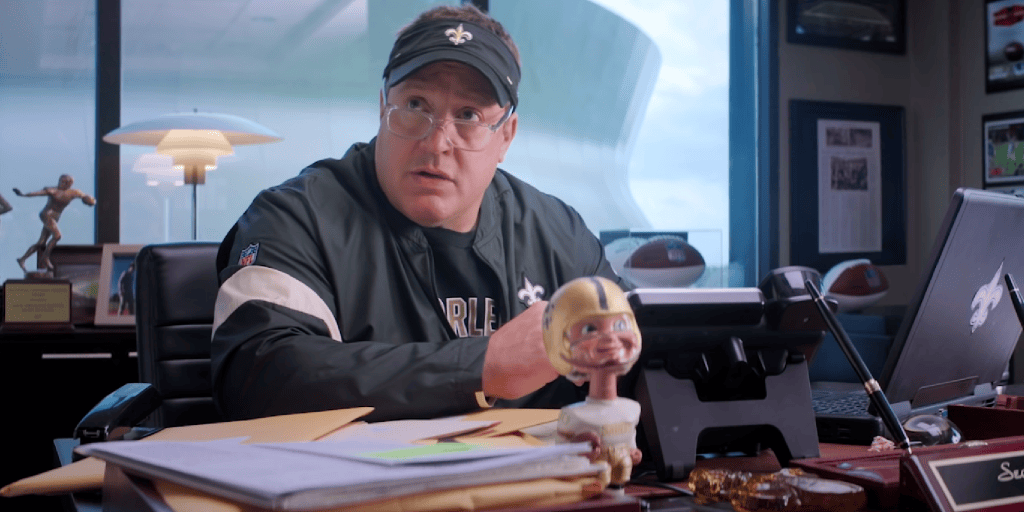
    Super Bowl championship winning coach Sean Payton announced he was leaving his New Orleans Saints after 16 years with the franchise last week.

    Just days after his decision, a brand-new Netflix film about a pivotal moment in Payton’s coaching career ironically debuted focusing on yet another time Payton was away from his Saints.

    Home Team, a collaboration between Adam Sandler’s Happy Madison Productions and Netflix, is based on his life during the 2012 NFL season, where Payton was suspended by Commissioner Roger Goodell for an entire year due to a scandal where assistant coaches paid bounties to players for injuring their opponents.

    The Kevin James-led film follows Payton back in his hometown of Argyle, Texas, where he helps a rag-tag middle school football team, including his young son Connor, turn around a losing season.

    James is perhaps the most serious he has been in his entire filmography as Payton, a man struggling to find his identity without a job for a year while trying to reconnect with his son. James has truly funny comedic moments that come as natural extensions of the script rather than the comedian trying too hard to force the issue and over-power the punchline.

    There’s a genuine warmth to his performance that endears the audience to Payton’s plight and helps build the foundation of an easy, yet enjoyable sports comedy.

    Twilight star Taylor Lautner plays the team’s young head coach and while his performance is somewhat static and monotonous, it plays well opposite James and some of the more outgoing young stars on the team.

    Because every football movie seems to require an alcoholic assistant coach, Gary Valentine stumbles through his lines physically and verbally as Mitch Bizone. For a PG-rated film, pre-teens may find Valentine’s performance comedic, but it truly comes across as ineffective and just slightly over-the-top.

    Rob Schneider plays Payton’s ex-wife’s new husband, a vegan holistic teacher who serves no real purpose other than to make James seem more normal and relatable by comparison.

    Directors Charles and Daniel Kinnane do their best to mimic classic sports films like The Bad News Bears and The Sandlot with their film and, at times, their direction evokes those films in a positive light.

    But for the most part, Home Team suffers from the same overwrought sports cliches that plague so many movies in this genre and leans in a bit too much into the light-hearted, boisterous physical comedy prevalent in Sandler-produced films. There are several extraneous characters written into the screenplay from Chris Titone and Keith Blum that feel design just to elongate the film’s running time and Texas football fans will have issues with the timeline and season schedule represented for middle school teams in the movie.

    As Netflix films go, Home Team is at best a middling feature not worth a look for adult cinephiles who haven’t poured through the studio’s extensive catalog of prestige films like The Power of the Dog and Tick, Tick, Boom. But for young moviegoers looking for something along the same lines as American Underdog that they can watch in the privacy of their homes, they could do far worse.

  • Mass: Big drama in small spaces

    Mass: Big drama in small spaces

    Robert Redford’s Sundance Film Festival has always been the premiere way for independent filmmakers to debut their work and kick off a full year of promotion to find an audience.

    This year’s festival has gone digital due to the Omicron variant of COVID-19 preventing cinephiles from catching the best 2022 has to offer so far in person, but 2021 Sundance entries are making their way to general audiences.

    Without question, the best film at last year’s festival comes from first-time writer/director Fran Kranz, who astonishingly crafts an intensely theatrical film plugged into current events and sure to tug at heart strings.

    Mass has a simple through-line. Two couples meet in a church basement to discuss an unforgivable tragedy. One couple’s son murdered the other as part of a mass shooting at a local high school and as part of the intense healing process, both couples agree to meet to discuss their sons’ lives and grieve.

    The four stars at the center of the film are expertly cast and all deliver remarkable performances worthy of making Mass the best ensemble film of the year and any of the four leads worthy of individual recognition.

    Ann Dowd’s Linda shows remarkable perseverance and boundless empathy despite the emotional devastation of her son’s actions, perfectly balancing Reed Birney’s matter of fact melancholia as Richard, the father who felt incapable of helping his son.

    Jason Isaacs covers Jay’s self-righteousness with a methodical, deliberate pursuit of understanding that borders on callous without completing crossing the line, while Martha Plimpton’s Gail expertly harbors anger mixed with profound sorrow without a real place to put either.

    While the physical distance between the four actors feels wide in the intimately tight shots Kranz chooses, their emotional distance is even more pronounced, a testament to just how specific and nuanced each choice of gesture, emphasis of phrase, undercutting of dialogue is. 

    Birney and Dowd have an unspoken chasm between them as Richard and Linda still cannot fully comprehend the rationale of their son’s actions, which has driven a wedge in their marriage.

    Jay and Gail have a much more supportive relationship that Isaacs and Plimpton timidly show in smaller moments of Mass, but each showcase how their pain manifests on an individual level that neither can truly console the other about.

    Kranz’s near-flawless screenplay takes the proper amount of care to establish what needs to be explained to the audience while not spoon-feeding them everything like many dialogue-driven films feel compelled to do.

    Tension and apprehension build slowly over the course of the first thirty minutes as the two couples prepare to meet and spend awkward early moments together.

    The film’s cinematography is not obtrusive, but not overly simplistic either as Kranz and cinematographer Ryan Jackson-Healy press in on the actors’ faces as events unfold to hyper-focus on reactions and intimidate revelations. This works especially well with the extensive and much needed cross-cut editing style of Yang-Hua Hu, who balances the emotions of whoever is speaking with genuine reactions of those hearing them.

    Visually, Mass begins mostly with the actors shown in pairs, capturing Jay and Gail supporting each other or Richard and Linda sharing stories in two-person frames. By the climax, however, Franz cuts the room down even further, keeping each actor secluded in their own frame to maximize the isolation each character feels and heighten the dramatic tension with rapid-fire cross cutting in a way that makes Mass more like a cinematic experience than just an exceptionally well filmed stage play.

    For a film that takes place almost exclusively in a small room with four people seated around one table, the visuals and editing give Mass a larger-than-life aesthetic that pushes the audience into the fray of these conversations as if viewers are observing from just a foot or two away.

    Every moment cinematically is considered carefully in choosing the focus, often keeping audiences hearing the words of a vulnerable Linda while staring into the heartbroken eyes of Gail or pressed into the snarl of Jay’s disgust as Richard describes ignorance of perceived warning signs.

    If the camera panned wider or the script was done as a stage play, audiences would be so hyper-sensitive to watch the speaker that they would perpetually lose the masterful non-verbal reactive work, which becomes almost more important than Kranz’s words or the actors’ line delivery. The emotion comes from seeing the pain in an unflinching, closeup way that only cinema could provide.

    A sure-fire winner at the Film Independent Spirit Awards, Mass also has somewhat of a chance to factor into this year’s Oscar race with Dowd’s performance seeming like the best opportunity to be recognized as a supporting actress if eligibility allows.

    Now available to a wider audience, Mass is an absolute must-see film for cinephiles looking for a substantial drama sure to make an impact in the relative doldrums of January.

  • The Tragedy of Macbeth: The weight of language

    The Tragedy of Macbeth: The weight of language

    Adapting the works of William Shakespeare from the stage to the screen is a time-honored tradition of prestige filmmakers.

    Bringing the bard’s words to life in a way that casual audiences can understand and appreciate is perhaps the most difficult task of any director, theater or film. Shakespeare’s complicated lyrical prose uses far too many metaphors and overly floral language for the lay person to understand without a dictionary or several times reviewing and understanding the text.

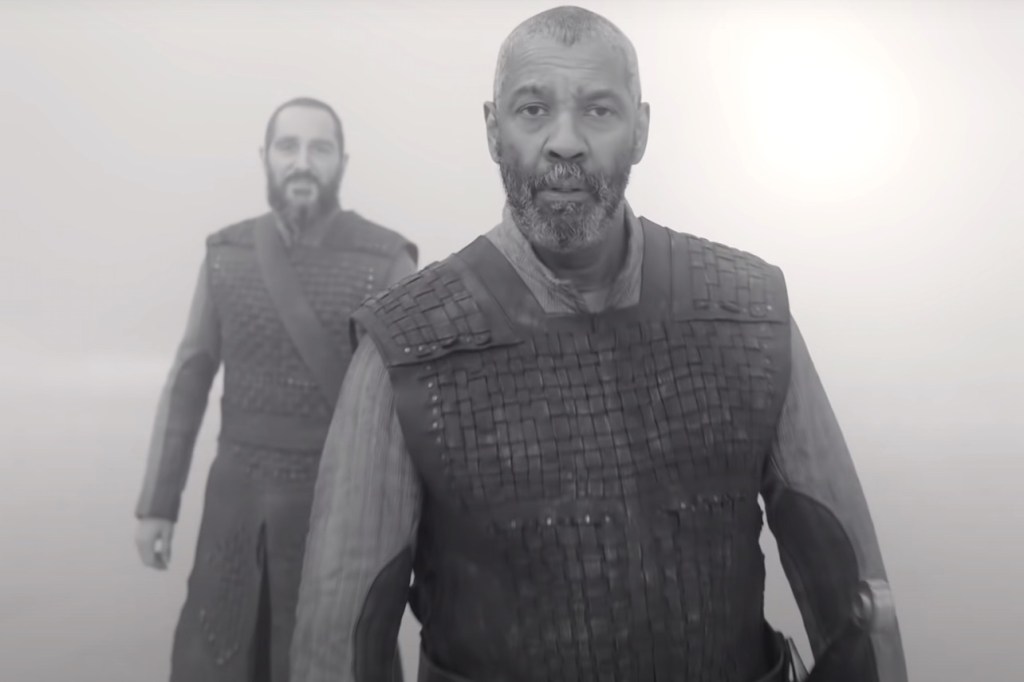
    Joel Coen, working for the first time separately from his brother and filmmaking partner Ethan, takes aim at one of the English playwright’s most demanding works, a five-act epic with misery, madness, murder and mayhem.

    The Tragedy of Macbeth, trimmed to a 105-minute retelling, finds the titular character immediately after winning a major battle for the Scottish army when three mysterious witches tell him that he is to become a higher noble, and soon after, king. This destiny manifests itself through treachery at Macbeth’s hand pried on by his manipulative wife and results in the destruction of countless noble lives.

    Denzel Washington is at his most compelling, yet manic performance that he’s given in years as the titular Macbeth, operating calmly, frantically and devolving to outright insanity in a matter of moments. His Macbeth seamlessly devolves into madness without any grandiose gestures or raving soliloquies. It’s a slow burn descent fueled by inner pain.

    At his right hand, Frances McDormand revels in the classic lyrical style of Shakespeare’s language and delivers Lady Macbeth’s dialogue with a poisonous tongue fitting of the villainess but with a self-righteousness that belies the evil within her heart.

    The film is also bevied by a tremendous supporting cast including Brendan Gleeson’s commanding presence as Duncan and Corey Hawkins’ redemptive hero in Macduff.

    Coen’s most masterful piece of filmmaking comes not from the expert performances he pulls, but from the bizarrely wonderful visual moments he creates from 4×3 framed black and white cinematography that blends the world of theater with cinema in sharp, eccentric ways.

    Cinematographer Bruno Delbonnel takes the intimate soundstages Coen chooses to stage his theatrical play on and coats them with layers of cinematic light and shadow to create a much more elegant backdrop than the film actually deserves.

    Visually, The Tragedy of Macbeth is among the year’s sharpest, most engaging features and left on silent, it would make a constant moving art gallery worthy of its own show in New York or London.

    Unfortunately, the film is painstakingly dense and inaccessible to the point that its ease of access streaming on Apple TV will make Coen’s film something audiences will frequently pause or outright turn off. There isn’t enough dynamic cinema to maintain a solid interest for the full run time and the weight of the faithful adaptation of Shakespeare’s dense language will force some viewers to stop, Google and rewind scenes several times just to figure out exactly what is happening or what is being said.

    This ultimately lays on the feet of the filmmaker himself, who truly isn’t making The Tragedy of Macbeth for anyone but himself. And while the most deliberate of cinephiles or Shakespearean scholars will love the authenticity of the project, most of the nuance will fall flat for those who either don’t know what to look for or can’t interpret Coen’s film properly.

    Because this is a prestige film with A-list actors with a classical background, it’s nearly impossible to believe that The Tragedy of Macbeth won’t be a major contender come awards season with acting nods for Washington and McDormand almost a certainty and a best picture nomination increasingly likely by the day.

    The Tragedy of Macbeth is far from the easiest watch in 2021, not simply from the content itself, but just as much from how Coen struggles to bring Shakespeare to life in an easily digestible way. Nevertheless, the film’s star power and quality moments however frustrating make The Tragedy of Macbeth something worth taking a chance on for those already with an Apple TV subscription.

  • The Tender Bar: Uneven family drama

    The Tender Bar: Uneven family drama

    Slice of life Americana films only truly work about once in every six or seven attempts.

    Most of the time, these period-driven, small town family dramas attempt to bite off more than they can chew by introducing more characters than they can give adequate time to or by muddling the narrative with time jumps or by simply being bland.

    All these things, unfortunately, are true of George Clooney’s latest directorial effort, The Tender Bar, recently released in theaters and now streaming on Amazon Prime.

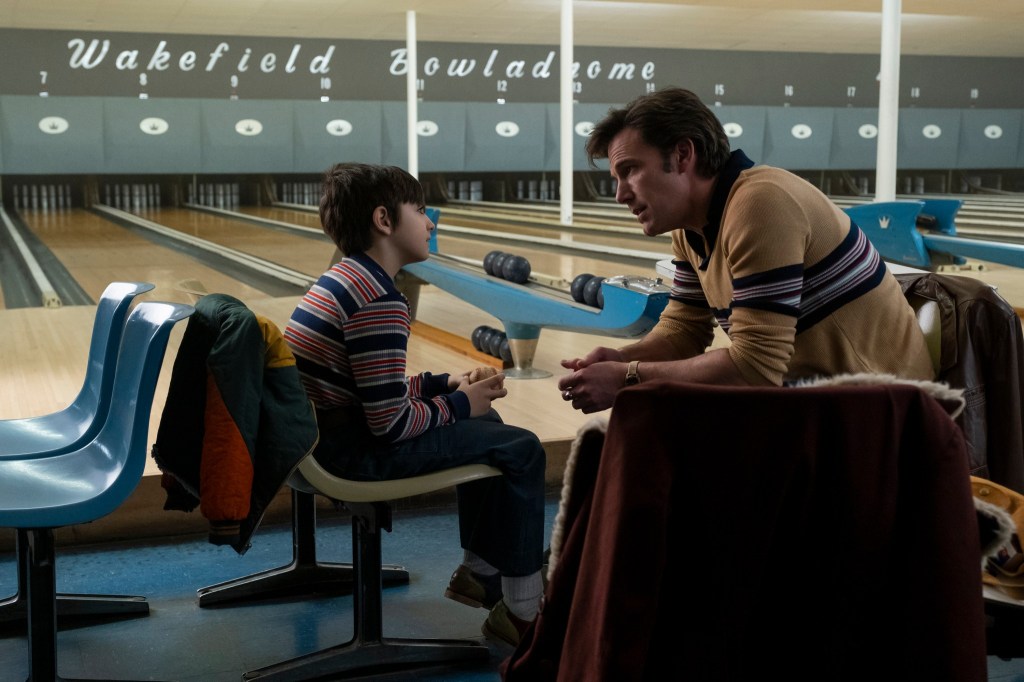
    Based on the memoir by Pulitzer Prize winner J.R. Moehringer, The Tender Bar follows a young boy with an absentee father growing up on Long Island in search of male role models and finding wisdom in his uncle’s tavern.

    Writer William Monahan, most notable for his screenplay for Oscar winner The Departed, provides Clooney with a wildly uneven script that has some terrific individual moments between a young JR and his uncle but languishes for far too long on JR’s college years without providing enough emotional connection to his youth.

    The result is an often tedious melodrama that leans heavy on the hard luck story of Moehringer’s youth much like last year’s Hillbilly Elegy, a big-budget, R-rated version of a Hallmark movie that fails to pay off emotionally in the end and will leave some viewers bored.

    By far the most compelling performance in the entire film, Ben Affleck shows incredible depth of heart behind a mostly stern and solemn face as JR’s uncle Charlie. Affleck is given the best lines in Monahan’s screenplay and delivers them with an unspoken compassion that radiates off the screen and allows audiences someone to bond with emotionally.

    He does a fantastic job introducing audiences to first-time actor Daniel Ranieri, who plays a nine-year-old JR with wide, inquisitive eyes and with a vast admiration for his uncle Charlie. Conversations between Ranieri and Affleck have genuine affection that leave viewers wanting more from the relationship than what Clooney and Monahan are willing to offer.

    Lily Rabe does a capable job of playing JR’s mother throughout, but with limited character development and Monahan largely sidelining her to highlight Charlie, there’s not much beyond a surface level examination of any of the women in JR’s life. His grandmother largely serves as a stand-in background character and audiences never truly get a picture of why JR becomes obsessed with his college girlfriend.

    Ty Sheridan plays the collegiate JR well, but the whole older JR experience is so clumsily written and staged that it’s impossible to separate his performance from the poor craftsmanship around it.

    There’s almost entirely no need for a voiceover in The Tender Bar, though Clooney and Monahan feel compelled to push one into the narrative randomly to help provide context that it appears they couldn’t put into the actual film through character work or an additional scene.

    Even though Ron Livingston’s cadence keeps in tone with the overall narrative, his presence simply cheapens the entire film and somewhat jars audiences the first time Livingston narrates.

    There are some sharp visuals at times from cinematographer Martin Ruhe and the score from composer Dara Taylor does well to round out some more compelling moments.

    Affleck received a Golden Globe nomination for best supporting actor for his work on the film, but it’s highly unlikely that it will translate to an Oscar nomination despite being the only real shot for The Tender Bar to receive acclaim from The Academy.

    The family-driven melodrama shouldn’t be anything potential viewers rush out to theaters to see, but the ease of access through Amazon Prime and exceptional work from Affleck in a large supporting role make The Tender Bar a mild, yet tepid recommendation.

  • Don’t Look Up: Stop worrying and love the comet

    Don’t Look Up: Stop worrying and love the comet

    Stanley Kubrick made Dr. Strangelove, a quintessential black comedy of the 1960s starring Peter Sellers as a treatise against the uneasy relationship between America and Russia’s nuclear arms race.

    It’s one of the driest modern comedic films with a biting screenplay and pitch-perfect acting that fully realizes its auteur’s vision and works on numerous levels for casual as well as fully engaged audiences.

    Adam McKay, the filmmaker behind several of this generation’s most beloved comedies, must be a huge fan of Kubrick’s seminal classic, as his latest feature takes a similar approach to modern politics and the public’s relative disinterest in the possibility for natural global catastrophes.

    Don’t Look Up is the third in a series of sardonic, topical films from McKay and his first collaboration with Netflix, an overly stylized movie that aims to be far cleverer than it actually is and misses the mark about half the time as the comedian strives to make too many social and political points.

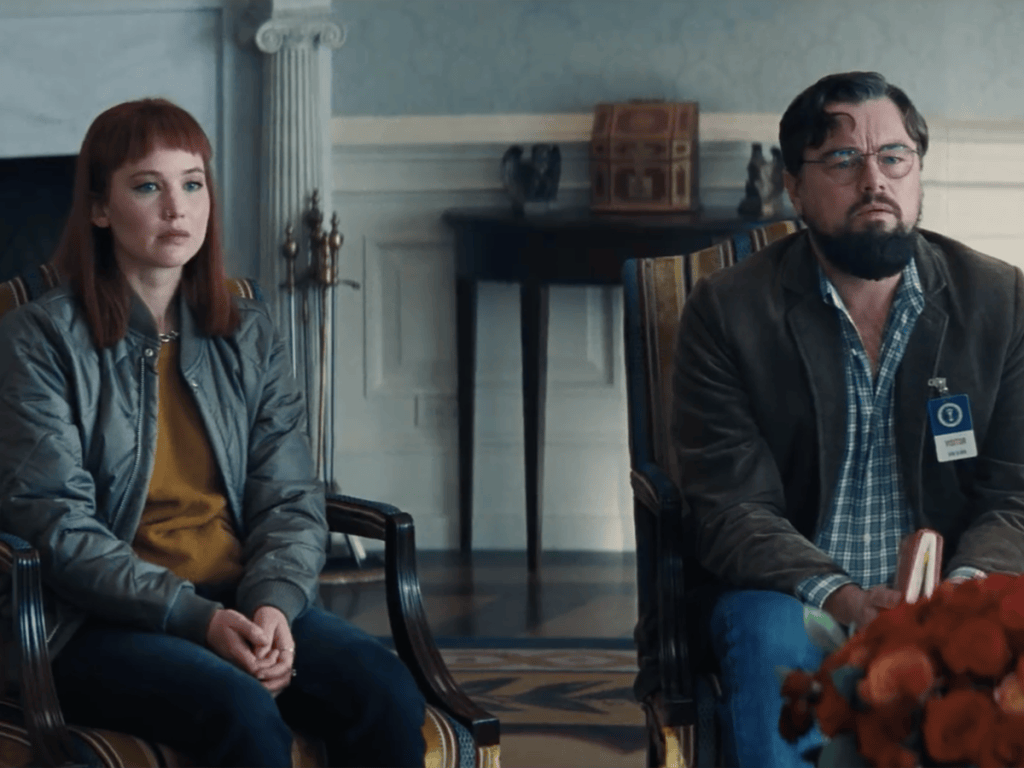
    Oscar winners Leonardo DiCaprio and Jennifer Lawrence star as a pair of Michigan State University scientists who discover a massive comet on a direct collision course with planet Earth that will wipe out all civilization. Although this is the basic premise behind disaster films like Armageddon and Deep Impact, McKay’s film takes a much calmer, more esoteric approach more in keeping with Kubrick’s passive-aggressive approach to message-based storytelling in Strangelove.

    Lawrence makes her cinematic return after several years off with her trademark sarcasm cranked up to an 11. The Academy Award winner relishes every opportunity to sink her teeth into cutting remarks written by McKay that seem targeted at other characters in the film but are truly meant for audience members at home to reflect on their own world view.

    By contrast, DiCaprio has the more mellow of the two lead performances, if such a thing is possible and masks his natural charm and good looks behind poor hair and shoddy glasses to allow a quiet, nuanced character to emerge. His Randall suffers from several psychological maladies from anxiety to depression that give DiCaprio a wide berth from which to play his most skittish role and often the most amusing character on screen.

    The film boasts an impressive ensemble cast with Tyler Perry and Cate Blanchett being the perfect foils for DiCaprio as a morning talk-show team that challenges his morality and sanity in a Network-esque fashion, while Meryl Streep and Jonah Hill are more frustratingly over-the-top as the inept president and her son, the chief of staff, meant to exaggerate the trivialities of the Trump administration.

    McKay actually has an impressive screenplay that is more sardonic and cutting than either of his Oscar-nominated films The Big Short and Vice. But as a director, he fails to bring his own writing to life consistently by keeping audiences out of the joke for far too long at moments and being overly ambitious in the editing room.

    Don’t Look Up jumps back and forth between scenes at a rapid-fire pace in an attempt to jar audiences awake to the messages McKay espouses in his narrative, but he goes to this well far too often so that it becomes messy and unnecessarily convoluted. 

    A big swing from an award-contending director with the most star-studded cast this season, Don’t Look Up likely won’t receive the accolades that Netflix might have hoped for when the studio acquired the project from Paramount Pictures and spent $75 million to make the film. There’s too much talent involved to completely count the picture out of races, but it’s unlikely that Netflix will push too hard with the more well-received drama The Power of the Dog also in the fold for the streamer.

    McKay’s film has a lot of individual moments that make Don’t Look Up a terrific black comedy warning about political and social divisiveness in a way that reflects Strangelove. But it’s terribly inconsistent in both its comedy and narrative structure, which makes the feature a frustrating film to watch.

  • Being The Ricardos: Sorkin’s big swing

    Being The Ricardos: Sorkin’s big swing

    Always the most cunning and captivating wordsmith, Oscar winner Aaron Sorkin grows increasingly sure-handed behind the director’s chair with each new project he takes on.

    Much like his writing, Sorkin becomes more daring as his confidence grows in his third feature film released last week in theaters and on Amazon Prime reflects both his drive and ambition to make prestige cinematic drama.

    Being the Ricardos is a quintessential Sorkin project filled with high-octane, rapid fire dialogue, intensely dry humor and an a stage play mentality that creates an alluring two hours for cinephiles to sink their teeth into. 

    This isn’t to say that the film is accessible to all audiences or will resonate with casual moviegoers. Sorkin takes a lot of liberties consolidating two years worth of real life drama in the lives of Lucille Ball and Desi Arnaz into one week’s worth of events surrounding the taping of an episode of their hit television show “I Love Lucy.”

    A radio broadcast accuses Lucille of being a Communist and a tabloid profiles Desi as a serial cheater all while the couple are announcing their second pregnancy to the show’s staff. It’s a cavalcade of events that Sorkin orchestrates with a deft pen and often compelling directorial eye. 

    Yet, Sorkin’s script feels more authentic if you consider the entire project a more fictionalized account that just happens to be based on real people rather than an honest work of nonfiction.

    He litters his screenplay with fictionalized retrospective interviews, often jumbling the timeline of events to fit a mood rather than provide clarity to the audience.

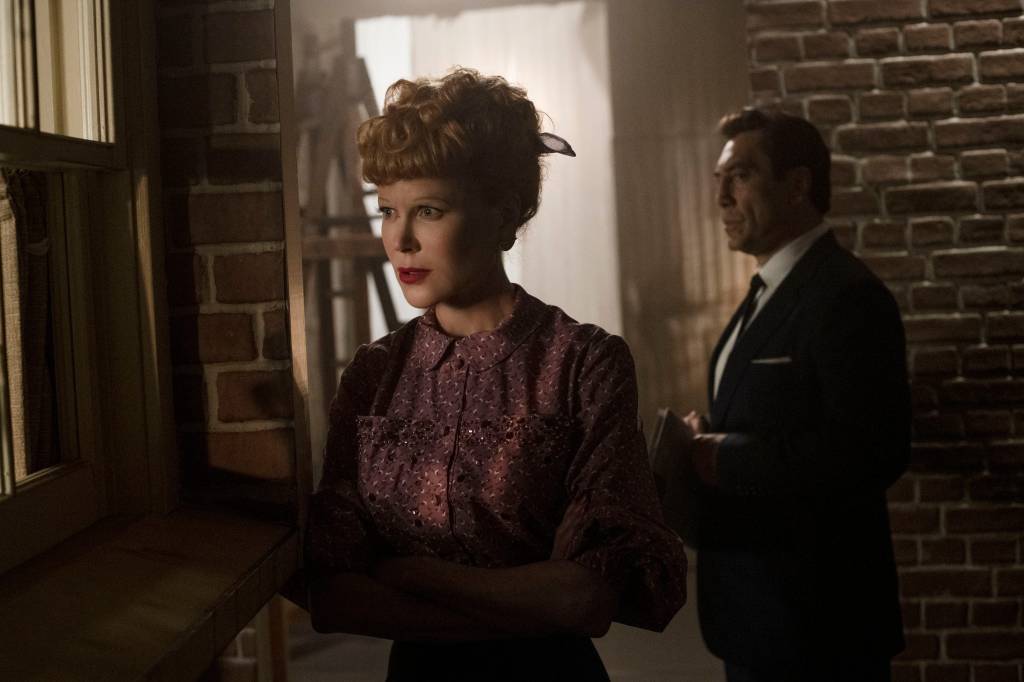
    The star of Being the Ricardos isn’t Lucille and Desi, nor A-listers Nicole Kidman and Javier Bardem who capably play both the real people as well as the “I Love Lucy” characters. It’s Sorkin, the guy waving his wand like a feverish maestro making a performance of his band leadership. There’s never a moment in the film that doesn’t have the good and bad of Sorkin’s growing auteurism stamped all over it. 

    It’s honestly too bad at times because Kidman is especially offering a compelling turn as Lucille and her ability to demonstrate both the unique physicality that Lucille had to set her apart as a comedienne and the deep thinking that helped shape the show and the people around her. 

    Kidman carries the film on her shoulders for much of the 135-minute run time and wonderfully rallies viewers to Lucille’s side with charm and becomes an ideal focal point for all the chaos that surrounds her. It’s a truly engaging look at the inner monologue of one of America’s first true television icons and while Kidman often doesn’t “look” the part, her ability to become Lucille and to a lesser extent, Lucy, is considerable and powerful.

    Bardem, by contrast, doesn’t give a character driven performance as Desi as Sorkin isn’t truly interested in finding Desi’s motivations.

    But Bardem brings charisma and machismo in spades and the turn is filled with a bravado that lights up the energy of the film at the drop of the hat. Desi’s scenes are always the most compelling because Bardem’s larger-than-life persona radiates off the screen and his chemistry with Kidman perfectly captures the hot and cold unevenness of Desi and Lucille’s marriage.

    The ensemble cast all give excellent turns as well with Nina Arianda’s Vivian Vance aka Ethel Merman and Tony Hale’s executive producer Jess Oppenheimer being standouts. 

    The film’s considerable production design pays off in a big way as viewers will easily feel themselves transported to 1950s Hollywood and its classical glitz and glamour.  Cinematography from Jeff Cronenweth only adds to the luxurious feel while also offering a sense of smoky haze pouring in during long office scenes. 

    Likely Amazon’s premiere contender for accolades this awards season, Being the Ricardos will probably fall short of expectations with only Kidman a probable Oscar nominee in Best Actress. Sorkin is always a threat for a screenplay nomination and films about Hollywood traditionally over-perform with Academy voters. 

    Being the Ricardos is a bold statement from Sorkin that will leave some viewers behind as he tries to be audacious as a dialogue driven filmmaker. But with the ease of access seeing the film on Amazon Prime, the mostly true story of the people behind Lucy and Ricky Ricardo is worth taking a chance on. 

  • Spider-Man No Way Home: Superhero movies are back

    Spider-Man No Way Home: Superhero movies are back

    Marvel Studios has had a problem for the better part of two years now. 

    Ever since the release of Avengers: Endgame in 2019, the Disney-owned franchise has been wallowing in a dilemma partially due to the COVID-19 pandemic and partially due to their own making. 

    With most of their Avengers core retiring from the Marvel Cinematic Universe, producer Kevin Feige has had to start from scratch building characters like Shang-Chi, countless Eternals and elevating secondary characters through their Disney+ miniseries. 

    Their one saving grace: a web-slinging superhero with the charisma and comic book nostalgia to bring the MCU into a post-Endgame era and reinvigorate dying box offices for theaters across the country. 

    Spider-Man: No Way Home, the third in a trilogy of films from director Jon Watts, brings Tom Holland back inside his spandex suit to take on even more classic villains, push a film franchise forward and captivate audiences with the most powerfully dramatic superhero film in two years. 

    It’s a film that does almost everything possible to rectify the star power issues created by the end of the Avengers saga and is the first universally beloved blockbuster since the pandemic changed how audiences watch movies. 

    Coming immediately on the heels of the events from Spider-Man: Far From Home, the final film in this particular trilogy finds the hero facing unwanted celebrity status after his secret identity is revealed to the whole world. When he asks Doctor Strange to cast a spell to make everyone forget his identity, the fabric of reality is torn and villains from other universes are thrust into Peter Parker’s path for him and his friends to capture. 

    Holland gives the best performance in his MCU career as Peter/Spider-Man, providing a deeper emotional impact than in previous films. It’s clear that at this point in his career Holland knows how to balance a character driven performance with a lighter, more accessible touch common to blockbusters. 

    He’s also deft at being a capable scene partner against any of the many more outrageous villains and other supporting characters, giving people like Willam Dafoe and Alfred Molina the width to delve into classic characters they haven’t visited in more than a decade. 

    His pivotal scenes opposite Dafoe and also Marisa Tomei’s Aunt May are among the most emotional of the entire MCU and maintain a darker tone that helps propel Spider-Man into a new era of cinema. 

    Benedict Cumberbatch as Doctor Strange ably plays the surrogate father figure to Peter that Robert Downey Jr. once did as Iron Man. While not carrying the film, Cumberbatch gives a great counterbalance emotionally to Holland that helps set up Peter’s uneasy relationship with the film’s many villains.

    No Way Home features an assortment of classic Spidey bad guys, but the standouts among them are Dafoe’s return as Norman Osborn and Molina’s second stint as Doctor Octopus. Both veteran actors perfectly tiptoe the line between friend and foe with Peter and elevate relatively cheesy comic book dialogue with gravitas.

    Watts does a phenomenal job of balancing the film’s complicated narrative with special fan service moments intended to satisfy comic book nerds and fans of the Sam Raimi trilogy or Marc Webb Spider-Man films. 

    Nothing feels too heavy for casual audiences and ardent Marvel fans who are careful enough to avoid major spoilers will be rewarded with truly special moments that will make audiences gleefully applaud. 

    There are several surprise cameos – both brief and extended – that elevate No Way Home and it’s the final ones that bring both unparalleled comedic and emotional impact that will help finalize decades of unresolved Marvel-related conversations. 

    One Oscar-nominated actor is the film’s most valuable character in spite of not appearing until the final act, offering up a heartfelt, earnest performance that reflects on Spider-Man films past and opens opportunities for new features. 

    No Way Home is the strongest entry in the Marvel Cinematic Universe since Endgame and helps to balance a franchise struggling to find their footing both creatively and at the box office. 

    Cinephiles and comic book fans who crave being in the middle of the conversation about big blockbuster films like this should rush to theaters as soon as possible to see 2021’s most impactful studio movie.