
The parallels are far too clear and distinct, so it’s best to just get them out of the way.
“Richard Jewell,” the latest docudrama from director Clint Eastwood, is a striking indictment of law enforcement officials too quick to judge and trigger-happy media outlets trying to scoop each other before confirming all the facts.
In very unsubtle terms, “Jewell” is a microcosm defense of the current U.S. presidential administration that seeks to endear audiences to an innocent man wrongly accused and equate his plight to today’s political climate.
That being said, Eastwood’s film is so much more than its ideology.
It’s a straightforward, brutal examination of a simple, genuine man ardently wanting to protect others and one of 2019’s most engaging features for good and bad.
Based on real events, “Richard Jewell” follows the title character – a freelance security guard working the 1996 Atlanta Olympics – who discovers a backpack bomb in a crowded concert area in Centennial Park, saving the lives of hundreds to instant media acclaim.
When the Federal Bureau of Investigation turns its attention to Jewell as a potential suspect in the bombing, a front-page story naming Jewell as the bomber changes an innocent man’s life forever.
Paul Walter Hauser gives perhaps the best performance of the year as Jewell with an approachable honesty to the portrayal that disarms the audiences and allows viewers to rally behind the character. Hauser is measured, yet free flowing in his work in a way that makes each line of dialogue feel spontaneous.
It’s a testament of Hauser’s immense talent that the earnestness Jewell displays over the course of the film can simultaneously be considered as an indictment by skeptical law enforcement and media in the film and as reinforcement of his innocence to the audience watching events unfold.
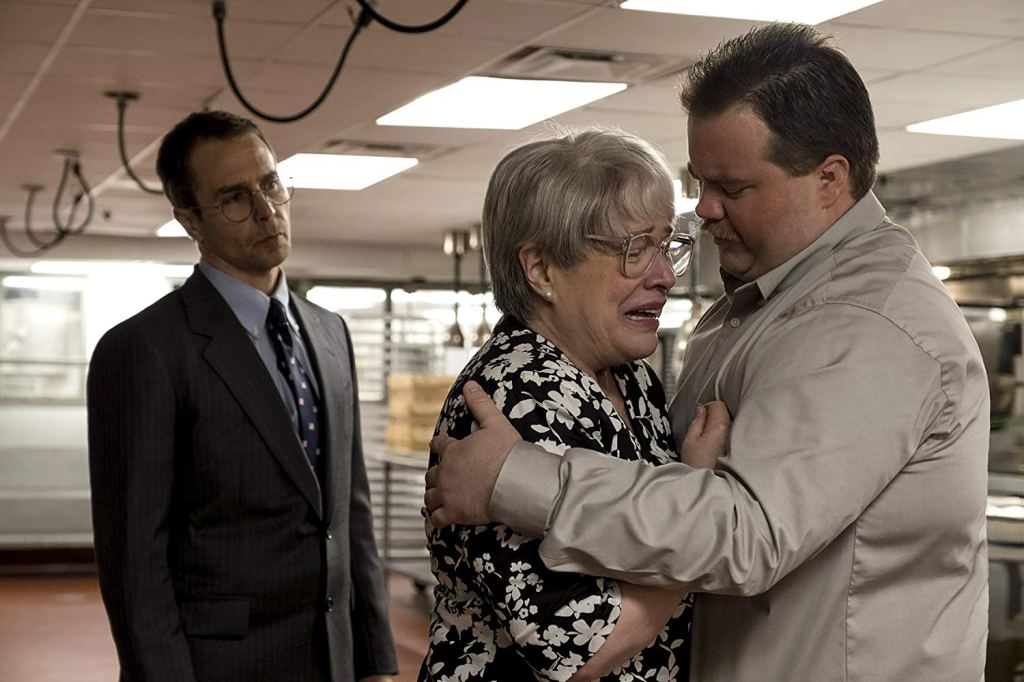
Hauser is especially captivating in scenes opposite Sam Rockwell as Jewell’s attorney Watson Bryant and Kathy Bates as Jewell’s mother, Bobi.
Both Oscar winners provide support to Hauser’s performance in different ways, Rockwell’s Bryant feeding confidence and anger to the flame and Bates’ Bobi Jewell taking on a large bulk of the emotional baggage.
The three actors work in synchronicity to allow Hauser’s natural cadences in the role to maintain a calm balance as an over-played Jewell would turn the audience away from his plight.
On their own, neither Rockwell nor Bates are doing anything exceptional, but speak volumes within the confines of how their characters impact Hauser’s steadiness in the title role.
Less successful are the film’s primary antagonists, Jon Hamm’s bullish FBI agent and Olivia Wilde’s controversial Atlanta Journal-Constitution reporter.
Thinly written and equally portrayed on screen, Hamm loses any pretense of impartiality within the first 20 minutes of the film in an increasingly smarmy turn while Wilde portrays Kathy Scroggins as a headline-obsessive journalist willing to trade sexual favors for tantalizing, unverified innuendo.
Both performances rarely exceed the level of mustache-twirling villain in the eyes of Eastwood and screenwriter Billy Ray, never leaving a shred of doubt or drama to the question of Jewell’s innocence.
“Jewell” struggles to maintain a clear visual composition in night scenes as Eastwood and cinematographer Yves Bélanger opt for authenticity in poorly lit areas rather than targeting specific lighting to enhance visibility. This is especially troublesome during the lengthy and chaotic recreation of the night of the bombing, where audiences are led bumbling through the relative dark out of confusion rather than increased tension.
Eastwood is notorious for shooting limited takes of scenes in his movies and rarely does it feel more apparent that early in “Jewell,” where care for the technical aspects of filmmaking seem to be shortchanged for a more laissez faire, “get the shot and move on” approach.
Both in the screenplay and the visual style, there’s a lot of potential for “Jewell” to be a richer film than it ultimately becomes.
There’s simply no chance for “Richard Jewell” to break into the Oscars race as its late release coupled with the political overtones of the film should keep it off January ballots.
Bates did receive the film’s lone Golden Globe nomination for supporting actress, however, and Hauser more than deserves universal acclaim for his work as the titular Jewell.
“Richard Jewell” is an uneven, yet captivating docudrama with an exceptional lead performance that deserves a wider audience than it will likely receive in theaters.


Leave a Reply