

Former lovers meet up for dinner, talking about the old days over wine and probing each other for information.
Over the course of a meal, the two fall in and out of love while harboring a weariness that keeps them questioning the other’s intentions and just how honest they are being with one another.
This conversation carries much of the weight in director Janus Metz’s adaptation of a novel written by Olen Steinhauer that sees these ex-CIA operatives questioning each other and themselves in search of a traitor who aided hijackers in a deadly attack on a Turkish Airlines plane years earlier.
The kind of movie that nowadays would be stretched into a 10-hour miniseries, All The Old Knives is tighter than it feels as Metz takes his time with the slow-burn pacing and meters out revelations deliberately to keep audiences from deducing the traitor too early.
Steinhauer adapts his own novel and pens an intricately dense screenplay filled with red herrings that pushes Henry to doubt his own instincts as he interrogates his ex-flame Celia, a prime suspect to be the mole.
Because so much of Knives is centered around a single conversation in a largely empty restaurant, Metz’s film requires a pair of actors capable of carrying long scenes without much action or demonstrative monologues. Chris Pine and Thandiwe Newton, at first glance, don’t seem like a perfect fit, but their chemistry makes more sense over time.
As the film progresses, Pine becomes far from the obvious choice to play Henry. In the flashbacks to 2012, he has the suave charm and looks to pull off being a deep cover operative; but in the present day, the decision to weather Pine in salt-and-pepper gray reduces the believability of his character.
Luckily, these segments are highly dialogue driven and Pine is able to convincingly balance Henry’s role as interrogator with that of a former lover longing to have Celia back in his life.
Newton has a much harder role to play as Celia, with the present day version being especially apprehensive for unclear reasons while in flashbacks, her vision is clouded by a deep love for Henry. It’s rare that audiences truly know what’s going in either character’s head and Newton does a fine job of masking Celia’s thoughts behinds a veil of timid uncertainty.
Aside from Pine and Newton, most of the other characters are largely relegated to the background. Lawrence Fishburne does a solid job as the station chief, while Jonathan Pryce is exceptional in a role much too small for the quality of work he delivers here. Even with an overly long running time just under two hours, Knives could have used an extra scene or two between Pine and Pryce catching up in a London pub.
Knives is highly edited and crosscut in between time periods and within scenes of dialogue to always keep viewers engaged, although the frequent back and forth could prove to be too much for some audiences. The film could also benefit from a bit more streamlining of the constant time-jumping, but location changes and the color of Pine’s hair from moment to moment help keep audiences in the relative know.
Cinematography from Charlotte Bruus Christensen is often striking, but Metz often forces the camera in more tightly than necessary in dialogue moments leaving the entire film a touch cold in spite of the warmth Christensen provides in lighting scenes.
While not the most cinematic film that would demand a trip to theaters, All The Old Knives may prove worthwhile to cinephiles appreciative of a slow-burn character driven drama thanks to its ease of access on Amazon Prime.

Nowadays it seems that studios aren’t really trying as much to hide their greed, especially when as it relates to comic book movies.
Just one month after Warner Brothers dropped a fantastic, original, and darker take on a classic comic book hero with The Batman, audiences have to suffer through the complete opposite.
Pushed off for nearly two years due to both the COVID-19 pandemic and its horribly lackluster screenplay, Morbius arrived in theaters this past weekend as Sony looks to capitalize on its hold on Spider-Man related properties by focusing on the web-slingers antagonists.
A vampire movie that isn’t a horror film and a comic book movie without much excitement, Morbius is a “yada-yada” installment in Sony’s developing Spiderverse, one that brings almost nothing to the table but something that viewers will have to see to fully understand the subsequent films in the expanding universe.
And this isn’t to say that Morbius is required viewing for upcoming Marvel projects.
Clearly Marvel chief Kevin Feige isn’t involved in this project with Sony in full control of the independent feature, though a post credit sequence will leave some audiences confused. There are mild references to the events of the significantly superior Marvel Cinematic Universe film Spider-Man: No Way Home, but this isn’t at all the direction the MCU is headed.
One studio – Marvel – has a clear vision for its cinematic future on both the big and small screen, while the other – Sony – is just throwing things against the wall and seeing what sticks.
This worked with the first Venom movie as actor/producer Tom Hardy had a distinct idea for how to make the symbiote translate on the big screen visually and comedically, but even that fizzled out on a subpar sequel.
With Morbius, director Daniel Espinoza and star Jared Leto seem to be simply going through the motions with a film so uniquely uninteresting that it doesn’t really matter if the title character will choose good or evil just as long as he does something worthwhile.
The premise of Morbius is relatively straightforward, if not inexplicable even by comic books standards. Biochemist Michael Morbius seeks to cure himself of a rare blood disease by splicing his DNA with bats, infecting himself with a hyper-stylized form of vampirism instead. There’s a secondary storyline with an adopted brother who has the same affliction, but the stakes of Michael’s relationships with him and love interest Martina Bancroft are so thinly constructed that they feel like total afterthoughts.
The decision to keep Morbius at a PG-13 rating is nothing more than a desperate attempt to cash in. Espinoza’s film needs to be rated R to showcase the violence and brutality needed to give a vampire with a conscience any true moral dilemma. When the audience doesn’t see and cannot fully realize how sadistic the bloodlust of the vampire is, it’s impossible to find any way to connect to the storylines or the characters themselves.
Leto himself isn’t doing the film any favors emotionally, offering a relatively muted performance outside of some solid physicality to highlight the effects of Michael’s disease and he’s routinely outclassed in scenes opposite Doctor Who star Matt Smith as Milo.
There is one solid sequence featured heavily in the trailers after Michael’s vampirism emerges on a cargo ship that provides some excitement, but the action in Morbius is too infrequent to keep audiences engaged and poor CGI work in the final moments will leave a sour taste in viewers’ mouths.
Morbius is a film hardcore comic book fans will need to see at some point if they want to have a full picture of where Sony is taking their Spiderverse, but there’s no reason to rush out to theaters for this toothless picture.

Fourteen months ago, a small independent film with a largely unknown cast and an Oscar winner in a smaller supporting role debuted to critical acclaim at the Sundance Film Festival, winning top prizes and a hefty payday from Apple.
The grand jury prize winner was expected to help launch the second wave of subscriptions to AppleTV+, a burgeoning streaming service fighting an uphill battle with stalwarts like Netflix, Amazon and Hulu for viewership.
Critical success continued when CODA, director Sian Heder’s heartwarming family coming-of-age dramedy, arrived on the streamer last August, but didn’t seem to draw attention in the same way from casual audiences.
Now there’s not really an excuse for ardent cinephiles to miss CODA despite being exclusive to a secondary streamer as the film took home three Academy Awards including Best Picture Sunday evening during a very congested ceremony that may continue to overshadow this smaller feature.
Adapted from the 2014 French film La Famille Bélier, Heder’s drama stars Emilia Jones as Ruby, a CODA or “child of deaf adults,” who longs to pursue her passion in music but fears abandoning her parents as the family’s fishing business is threatened.
It’s the first feature film to debut at Sundance and go on to win Best Picture, and in large part, the underdog win can largely be attributed to the film’s terrific cast of predominantly deaf/non-hearing members that provide the humor, heart, and passion of CODA.
Troy Kotsur rightly earned his Best Supporting Actor Oscar with a truly layered turn as Ruby’s father Frank, who wonderfully portrays anger and frustration over struggles with the business in one scene and can effortlessly wash that all away to carry the film’s funniest moments as one-half of an awkward parental unit with Marlee Matlin.
Kotsur’s Oscar moment late in the film in a scene opposite Jones where the two are able to bond over music despite their hearing differences certainly propelled CODA to its win and it’s a genuinely heartwarming moment.
Jones also has terrific chemistry with Daniel Durant, who plays Ruby’s brother Leo, and it’s Durant’s brash attitude in being the overlooked older brother that helps solidify the terrific family drama.
CODA suffers somewhat from attempting to bridge together two separate films into one and the quality balance doesn’t quite matchup between the two, which makes its Best Adapted Screenplay win somewhat befuddling. Perhaps voters keyed in on the 40 percent of the script in American Sign Language, which held most of the emotional moments that pulled on voters’ heartstrings.
The core of the film, where Heder really shines, is in the family drama with Ruby’s struggles to become her own person outside of interpreting for her father and brother for their fishing business. When CODA leans on its deaf cast members, the film is engaging, unique and poignant.
There’s a secondary storyline that runs largely parallel to the family dynamic that doesn’t particularly mesh well until the final moments of the film. Ruby’s love of singing and involvement with her school choir often feels like an overextended episode of Glee, which is referenced in the movie. Giving this plotline equal weight in the running time – especially with an unneeded love interest – makes CODA artificially long at nearly two hours and separates viewers from the best parts of the film.
Winning Best Picture gives CODA the higher profile needed to draw audiences in who otherwise would never make an effort to seek it out. But it’s disappointing to see films with greater technical merit and artistic vision not rewarded more for their boldness and risk-taking.
CODA is far from an unworthy winner and its warmth, heart and uplifting narrative make it the crowd-pleaser that any cinephile would enjoy on a casual Friday night at home.

Director Adrian Lyne, the filmmaker behind some of cinema’s most compelling erotic thrillers, hasn’t stepped behind the camera in two decades.
The mastermind of Fatal Attraction, Indecent Proposal and Lolita last put out a new movie in 2002 with Unfaithful, a sexy Diane Lane and Richard Gere film that quadrupled its budget in box office revenue.
With plenty of time to craft his next project, a pair of beautiful stars in the leads and a script based on a story written by the author behind Strangers on a Train and The Talented Mr. Ripley, there shouldn’t have been any reason why Lyne couldn’t execute his vision for a steamy psychological ride that would leave audiences on the edge of their seats for hours.
That’s perhaps why it’s so disappointing that Deep Water, the latest Hulu original film to hit the streaming service, doesn’t quite maintain its spark in a disjointed feature with lofty highs and lackluster lows.
Lyne’s film follows Vic Van Allen, a husband teetering on the edge of divorce who allows his wife Melinda to carry on several affairs, although each man who enters the picture mysteriously disappears along the way with Vic as the prime suspect.
Ben Affleck continues a strong run of character driven performances in recent years as Vic, often brooding through his home with a distant stare that belies unspoken intensity underneath.
When the situation calls for it, especially in conversations between Vic and other men, Affleck is cerebral and direct in his affectation, driving his point home with a callously calm intimidation to leave viewers guessing.
Ana de Armas counters Affleck’s more subdued control with a sensual free-spirited approach to Melinda. The chemistry between the two is chaotic and electric. Neither performer fully trusts the other, nor really understands the psychology of their partner and their unease provides the perfect recipe to foster audience suspicion on both their parts.
Well into the R-rated category essential for successful erotic thrillers, Lyne makes sure his film oozes sexuality through regular, but not gratuitous nudity and intensely intimate moments that further the complexity of Vic and Melinda’s relationship.
The supporting cast is often treated as disposable as Melinda’s erstwhile lovers, but Grace Jenkins often steals scenes as the Van Allen’s adorable daughter Trixie and Tracy Letts provides much needed gravitas as a friend with concerns about Vic’s motives.
Though it’s largely a well-shot and well-crafted movie, Deep Water is vastly disappointing at times with its cinematography when Vic and Melinda are driving around town. The shots are hastily put together and the use of green screen technology to layer in the background is shoddy and distracting, especially when looking through the rear window.
So often, moody moments where composer Marco Beltrani’s score helps paint a picture of a marriage in disarray is paired with deafening silence in the attitudes and faces of Affleck and de Armas, only to have the whole scene ruined by obtrusive lights that feel completely out of place.
Lyne does a terrific job however framing the audience geographically in each of the film’s locations from the outset. He smartly establishes the sizeable emotional gap in Vic and Melinda’s marriage through an early shot of a stairwell in the couple’s Louisiana home. Melinda disappears up a flight of stairs to the right after glaring wistfully at her husband only to have Vic venture up the adjacent stairs to the left, the separation between them clear from simple blocking.
The biggest flaw of Deep Water likely is a result of the COVID-19 pandemic as the film was slated to be released in theaters nearly two years ago. It seems the delays caused the filmmakers to overanalyze their screenplay, trimming nearly a half-hour out of the running time.
What happens in the final cut, unfortunately, is a rushed ending with several unfulfilled or short-changed storylines as if the majority of the third act was abruptly removed. This does help maintain the focus on Vic and Melinda, although much of the larger world-building Lyne establishes in the first 45 minutes becomes wasted as a result.
Deep Water would have been a major disappointment in a theatrical setting, where its subpar cinematography and disjointed screenplay would prove fatal. But in a more casual streaming setting, it’s exactly the kind of tawdry erotic thriller that could charm ardent cinephiles for a couple of hours on date night.

Director Domee Shi isn’t a household name in animated film like Brad Bird, creator of the Incredibles films or Pete Doctor of Inside Out and Soul, are synonymous with Pixar movies.
But the Chinese-Canadian filmmaker has developed a career out of making animated movies pulling from her heritage, first with the Oscar-winning short film Bao in 2018 and now with her major feature Turning Red, which forgone theaters and moved immediately to the Disney+ streaming service this weekend.
The film is the second straight Pixar release to premiere exclusively on Disney’s online streaming platform due to the COVID-19 pandemic following Luca last year and while this allows the film to reach a wider audience more easily, Turning Red suffers from lack of studio support and almost feels like an afterthought from a studio whose most successful film in recent memory, “Encanto,” is likely to win multiple Academy Awards later this month.
Shi’s film follows 13-year-old Meilin, an introverted, academic-oriented eighth grader with a small group of close friends who bond over a mutual love for boy band “4Town.” They plan to attend an upcoming concert in their hometown of Toronto, only to be waylaid by Meilin, who turns into a giant red panda when overly excited.
Rosalie Chiang provides a bright cheer to Meilin, especially when narrating in the first act of the film. When Meilin turns into the panda, Chiang adds a slight panic to her cadence that accentuates Meilin’s frantic excitability.
Sandra Oh is exceptional as Meilin’s overbearing mother Ming and her line readings of Ming’s frequent screeches instantly transport audiences back to their own childhoods during those moments where their own parents unintentionally embarrass them.
The best animated portions of the film are when Meilin is in panda form as Turning Red becomes more visually dynamic with a better character model than Meilin in human form.
Parents of younger children should probably watch Turning Red on their own before deciding whether to allow their kids to watch the film. Some of its rebellious themes, sexual innuendos and allusions to menstruation may not be subjects parents would approve of.
Pixar’s animation is largely sharp throughout and Shi integrates Japanese anime style often into the design of the film when characters get excited, representing this glee with bulging eyes on the verge of tears that comes from the anime influence.
The contrast in light and shadow Pixar’s animators are able to develop create a genuine three-dimensional element to the film that also is among the visual highlights.
Though the film is set in the early 2000s, the only real signpost of the setting comes in the form of the boy band “4Town” that the girls try to see in concert from the opening moments of the film. In that way, Turning Red feels instantly dated as if it should have come out over a decade ago and not in 2022.
Billie Eilish and Finneas, likely to win an Academy Award for Best Original Song for their theme to the James Bond film No Time To Die, craft several catchy yet unmemorable tunes for “4Town” and it’s in the moments where Turning Red leans into its cultural roots that the film becomes something beyond a strange PG-13 coming-of-age dramedy.
Because it’s a Pixar film and released in limited theatrical markets to maintain eligibility, Turning Red is a likely contender for Best Animated Feature at next year’s Academy Awards, although the much more anticipated Lightyear spinoff of the Toy Story franchise this summer could push it out of contention.
Not nearly on the level of Disney’s far superior family magic film Encanto, Turning Red may not be an ideal choice for younger audiences nor as much of a wide-spread crowd pleaser although catching the film on Disney+ offers a great opportunity for families to try the largely entertaining movie at low cost.

How is it possible to craft a completely original take on a character that has been reset, rebooted and reimagined countless times in print and on the silver screen over decades?
It feels as if audiences, especially those soaked in comic book lore, have already seen every possible iteration of reclusive billionaire Bruce Wayne and his nocturnal vigilante alter ego Batman.
But director and co-writer Matt Reeves has somehow managed to capture the detective element of the character in a fantastic new noir, The Batman, which has rocked the box office to earn more than $120 million in its opening weekend.
The film follows a vengeful Batman as he and Gotham City police investigate the murders of several key political figures at the hands of a sadistic serial killer leaving riddles at every crime scene.
Reeves has designed his film in such a way that the usual duality between the Batman and Bruce Wayne personas of the character becomes incredibly lopsided in favor of Batman in this iteration. It’s clear that the filmmaker, and to some extent Pattinson, view Wayne as more of the costume and Batman the real person in a psychological sense.
Pattinson portrays the character with a weathered distance that isolates him emotionally and narrows the focus to deliberate, exacting violence and considered detective work in the shadows of the night.
A hero, no matter how reluctant, is only as good as his villain is bad, and Paul Dano’s Riddler is exceptionally twisted and damaged. Dano builds his character around the real-life Zodiac killer and his portrayal leans heavily into the tortured serial killer aesthetic physically.
Though they rarely share the screen together, Pattinson and Dano have better chemistry as antagonists than Pattinson does with “love interest” Zoë Kravitz as Selina Kyle. This isn’t to say that Kravitz isn’t solid in her role as Catwoman, but more on the fact that Pattinson plays Batman with so much disinterest in her welfare that their supposed flirtations feel clunky at times.
The film’s ensemble cast helps fully realize the deep world that Reeves imagines for Gotham City with terrific performances across the board. Jeffrey Wright as Jim Gordon and Andy Serkis as Alfred provide excellent mentor figures to Batman and Bruce Wayne respectively while John Turturro is astounding as mob boss Carmine Falcone and Colin Farrell disappears into his role as the Penguin.
Reeves does a lot of world building in The Batman that accounts for the nearly three-hour running time, but his deliberate pacing sometimes borders on excessively slow as he feels the need to show audiences every step of the plot in exacting detail.
Greig Fraser’s dynamic cinematography leaps off the screen at every turn and perfectly keeps in tone with Reeves’ desire to keep Batman (and the film as a whole) within the shadows as much as possible. The absence of color throughout and Fraser’s expert use of low light make every moment a brighter hue exists pop even more.
This is especially clear in some of the film’s more artistic moments where a fight sequence in a crowded hallway is illuminated only by gunfire or when Batman’s only light comes from a glowing red flare. Even when the screenplay and Reeves’ exceptionally elongated directorial vision stretch scenes to their limits, Fraser maintains audiences’ undivided attention with completely arresting visuals.
The look of The Batman from its production design to costuming to how completely unrecognizable Farrell is as The Penguin thanks to transformation by makeup and prosthetic artists gives Reeves’ film a gritty texture that heightens the noir aesthetic to astonishing levels. Michael Giacchino’s haunting score intensifies the fear and melancholy that oozes out of every pore in The Batman.
While it’s far too early to tell where The Batman might be under consideration for an award season that’s nearly a year away, Reeves’ film is certainly DC’s best chance to earn significant nominations since Christopher Nolan’s The Dark Knight fell just shy of a Best Picture nod at the 81st Academy Awards and won Heath Ledger a posthumous Oscar for Best Supporting Actor.
Easily the best film based on a DC Comics character in over a decade, The Batman is the year’s first signature blockbuster despite being overly brooding and should be something ardent cinephiles see on the biggest screen possible to fully engage with the dynamic cinematography and world building.

Trailers don’t always give the best impression of what a film actually is.
Sometimes it’s because the studio is attempting to trick potential viewers by showing the best clips in order to maximize profits. Other times, it’s simply because they don’t have any actual clue what kind of movie they have on their hands.
This is especially problematic for first-time directors, who have to focus on so many different filmmaking elements that they’re unable to home in on a specific tone or try to make their film one genre, when in reality it’s best served as something else entirely.
Such is the case for Dog, the co-directorial debut of Reid Carolin and Channing Tatum, working off a screenplay written by Carolin and starring Tatum as a former Army Ranger with traumatic brain injuries who is tasked with bringing his fellow Ranger to the funeral of a comrade hundreds of miles away.
The catch here is that Tatum’s partner for this road film is a Belgian Malinois and while Carolin and Tatum are hoping for laughter with a bit of character building, Dog is at heart a deeply introspective drama with the occasional lighthearted moment to bring levity to weighty concepts like post-traumatic stress disorder, suicide, and other mental health issues that plague returning military personnel.
In many ways, it reminds of a PG-13 version of Richard Linklater’s heavy road drama Last Flag Flying where the bond between former soldiers comes together over a lengthy trip to a funeral. Dog is exceptionally emotional in key moments as viewers learn more about Tatum’s Jackson and his health issues.
Tatum delivers some of his most considered dramatic work as Jackson and while it’s natural for him to ease into the more comedic physical elements of the screenplay, it’s clear from the outset that Tatum’s mind is more attuned to Jackson’s fragile emotional state. Tatum plays the part of a wounded soldier trying to toughen up beyond his means well and the conflict running through Jackson’s mind in the more somber moments of the film wear on Tatum’s face in a way that pulls the audience into his consciousness.
It’s tricky to pull off a two-hander film like this when one of the main protagonists is an animal, but Carolin and Tatum do a solid job of framing the three Belgian Malinois who portray Lulu in such a way that viewers can feel the dog’s emotions in deep, sad eyes and long panting breaths. The camera is often placed back and tilted up several feet away to make Lulu feel bigger than she probably is and also to help put her on more of a level playing field with Tatum.
Tatum does a fantastic job of showcasing Jackson’s evolving bond with Lulu, which can prove problematic when the scene partner can’t really conceptualize what’s really going on and help to give the actor something to work with emotionally. But throughout, the relationship between man and dog feels genuine, which is the key conceit needed to make the entire film work.
One of the most underrated things about Dog is the excellent use of the soundtrack, especially in the third act with the Alabama Shakes song “Hold On” anchoring a perfect edited scene transition on a downbeat as well as Chris Stapleton’s “Starting Over” helping to set the tone for the final moments.
While it certainly won’t be at the top of any year-end list and it’s wildly mislabeled as a more comedic film than what appears on screen, Dog is a pleasant surprise during a time when studios usually release their worst films and is something worth taking a chance on in theaters.

Almost by definition, films based on video games are subpar features meant to propel teenagers into buying the latest installment in the entertainment franchise on PlayStation, Xbox, or computer console.
Movie franchises have spawned from several popular titles over the years including multiple Tomb Raider installments, fighting series like Mortal Kombat and Street Fighter, as well as a Resident Evil series.
In recent years, PlayStation has been the most aggressive in attempting to develop its original content with several planned films and television series in the works. The first of which, Uncharted, starring Tom Holland and Mark Wahlberg, debuted this past weekend after being twice delayed in 2021 due to the COVID-19 pandemic.
Based on the action-adventure gaming franchise of the same name, Uncharted follows a young Nathan Drake as he is lured into a high-stakes quest for the long-lost treasure of world traveler Ferdinand Magellan by a fortune hunter who worked with Nathan’s missing brother Sam.
Perhaps the biggest flaw of director Ruben Fleischer’s film is Holland himself, who gives a charismatic performance as Nathan, but sounds and acts too much like his now iconic Spider-Man character to be fully believable here as a naïve treasure hunter. The young British actor pulls off his American accent quite well, and yet ardent Marvel fans will hear and see Peter Parker on the screen.
This especially occurs during the film’s numerous stunt pieces, which often require Holland to perform some sort of parkour leap or long swing that one might expect from a certain comic book webslinger. And while it’s to be sure that Fleischer is ramping up the dynamics of these sequences to give the video game aesthetic, Holland might not the perfect choice.
Wahlberg fares somewhat better as fortune hunter and erstwhile mentor Sully as his charisma and surly Boston personality makes him a solid antihero with just enough questionable motivations to create dramatic tension with Nathan.
The best performance in the film is given by Antonio Banderas, playing slightly against type as the heir to a global financier family with claims to the Magellan gold. It’s a welcome sight to see Banderas play someone this ruthless and the gravitas and edge he brings to the role makes for a formidable and logical foe in a film where logic is somewhat lax.
For an action-adventure movie, Uncharted has a lot of turn-your-brain-off style entertainment that can be a lot of fun in bursts, especially a cargo plane sequence ripped directly from one of the video games that sets the tone for both the first and third acts of the film.
Visually, Uncharted has some beautiful sequences that feel like the cinematic cut-scenes one might find in the video games and the exotic locations are treated as truly unique and special.
Fleischer doesn’t always find the right tone throughout as the film becomes a mixed bag of everything from National Treasure to Angels and Demons to the Tomb Raider movies without defining itself separately.
In spite of all of its many flaws, moviegoers desperate for a little bit of mindless fun and willing to go with the incredulous nature of the plot may find Uncharted worth taking a chance on in theaters.

Sometimes the best performances an actor can deliver on screen are the ones that closely mirror who they are in real life.
They could be portraying another actor and draw from their own personal experiences to get into the right state of mind or perhaps they have gone through similar struggles and find that the best way to connect to the character.
And yet, in some instances, a character can be written in such a way that it just feels like the actor portraying them is just being 100 percent themselves just with a fake name and made-up storyline.
Marry Me, the latest romantic comedy to arrive in theaters as well as streaming on Peacock, essentially asks the question, “What if Jennifer Lopez randomly proposed to an average nice guy on the street and brought him into the world of superstardom?”
Director Kat Coiro’s major feature film debut evokes the classic Julia Roberts rom-com Notting Hill but without the same amount of heartfelt laughter and emotion.
When pop superstar Kat Valdez finds out her fiancé is cheating on her seconds before a live televised wedding, she spontaneously opts to marry Charlie, a stranger in the crowd, instead.
Lopez plays a heightened version of herself as Kat in a performance that’s slightly naïve to the world around her and just wants to make genuine connections with the people in her life.
Her chemistry with the dorky, yet charming Owen Wilson can be a tad hit-or-miss, but where Lopez truly shines in Marry Me are in the film’s numerous musical moments. Backed by a soundtrack she created, it often feels like Lopez is shooting a music video with dazzling wardrobe, a cavalcade of dancers and a flashy, constantly moving camera.
When Marry Me is at its most entertaining, it’s Kat walking down a flight of stairs in a million-dollar ballgown while belting a ballad or a montage of Kat and Charlie’s lives being changed by the other while Kat records the song playing in the background. It’s the Lopez show from start to finish.
Wilson, on the other hand, is as understated as he can be as the everyday man that he’s played in film after film after film. His chemistry with Lopez isn’t exactly ideal but works in the context of this romantic comedy as it doesn’t really matter how connected Wilson and Lopez actually are. He is effective on his own, especially as a sympathetic teacher. In a larger context, however, it’s clear Wilson is not on the same page as Lopez in the overall scheme of Marry Me.
Among the supporting players, none is better than comedienne Sarah Silverman as Wilson’s coworker and guidance counselor who just happens to be LGBTQ+ to keep her from being a better match than Lopez. Silverman delivers the comedy from start to finish and is largely responsible for much of the laughs of Marry Me as well as the impetus of the film’s plotline as well.
Written by four screenwriters, the overall plot of Marry Me is so incredulous that It makes the traditional romantic comedy seem bland by comparison, but Lopez and Wilson make the script work in their favor to create a largely enjoyable film.
While it isn’t the kind of movie that would be recommended to travel to the theaters to see, the fact that it is equally accessible on the Peacock streaming service makes Marry Me worth a mild recommendation for moviegoers to seek out if they already have the streaming service.

Acclaimed auteur Guillermo del Toro hasn’t made a new film since winning both best director and best picture in 2018 for his eccentric feature The Shape of Water.
del Toro is known as a master of the avantgarde, relishing in the eccentricities of life and the oddities of horror for decades with everything from Pan’s Labyrinth to a pair of Hellboy films to an upcoming adaptation of Pinocchio for Netflix.
His latest film, Nightmare Alley, taps into del Toro’s love for the obscure and bizarre, all the while emphasizing the uniqueness of a period piece that twists and bends what the mind might find conceivable.
Based on both the 1946 novel and 1947 film of the same name, Nightmare Alley follows Stanton Carlisle, a man who joins the circus leading up to World War II after murdering a man and burning down his house. When he learns the art of mentalism from a “clairvoyant” couple, he sets off on his own for fortune that ultimately leads down a dark path.
Bradley Cooper provides a mostly stoic yet measured performance as Stanton and it’s a turn that helps ground the audience in the story without endearing them too much to his questionable choices.
While his chemistry with Rooney Mara’s Molly is somewhat shaky despite the plot’s desire to pair them, his ability to match Cate Blanchett’s mysteriously alluring Dr. Ritter makes for a scintillating repartee that anchors the back half of the film.
Nightmare Alley has an incredibly deep and talented supporting cast from David Strathairn and Toni Collette’s masterful work as the clairvoyants to Willam Dafoe’s circus leader to Richard Jenkins perfectly playing against type as a rich and nefarious widower.
del Toro’s film is a visual cavalcade of everything that makes del Toro one of the world’s premiere filmmakers. There’s so much depth to each scene with elaborate production design and set dressing creating a world in every location.
Cinematographer Dan Lausten creates a wide, expansive arena for cinematic beauty in every frame, longing for audiences to linger in the haunting complexities of del Toro’s vision. No matter what the camera is focused on, each character and set piece is framed and lit in such a way that demonstrably makes it feel like the most important moment in the entire film, which is an astounding feat for a feature littered with unforgettable imagery.
At a running time of 150 minutes, Nightmare Alley somewhat languishes out of the gate as del Toro deeply and richly builds the world of his film to the detriment of pacing. Once Stanton strikes out on his own, however, Nightmare Alley picks up considerably and becomes an exceptionally compelling noir.
The issue truly stems from del Toro’s insistence on creating a backdrop for Cooper and the rest of the cast to revel in. There isn’t much to define the story outside of the technical aspects for most of the first hour and many viewers may decide to opt out of the film altogether before things fully come to fruition.
As a result, Nightmare Alley is unlikely to receive any major acclaim come Oscars season, although it could do well in below-the-line categories like production design, cinematography and costuming.
While it might behoove ardent cinephiles to seek out specialty screenings of the film in its new limited black-and-white release, casual viewers might be more willing to take a chance on Nightmare Alley now that it has become easily accessible on Hulu and HBO Max. The vision of del Toro combined with masterful technical elements and compelling, yet somewhat thin performances make Nightmare Alley something worth taking a chance on via streaming service that they wouldn’t normally drive to a theater to see.
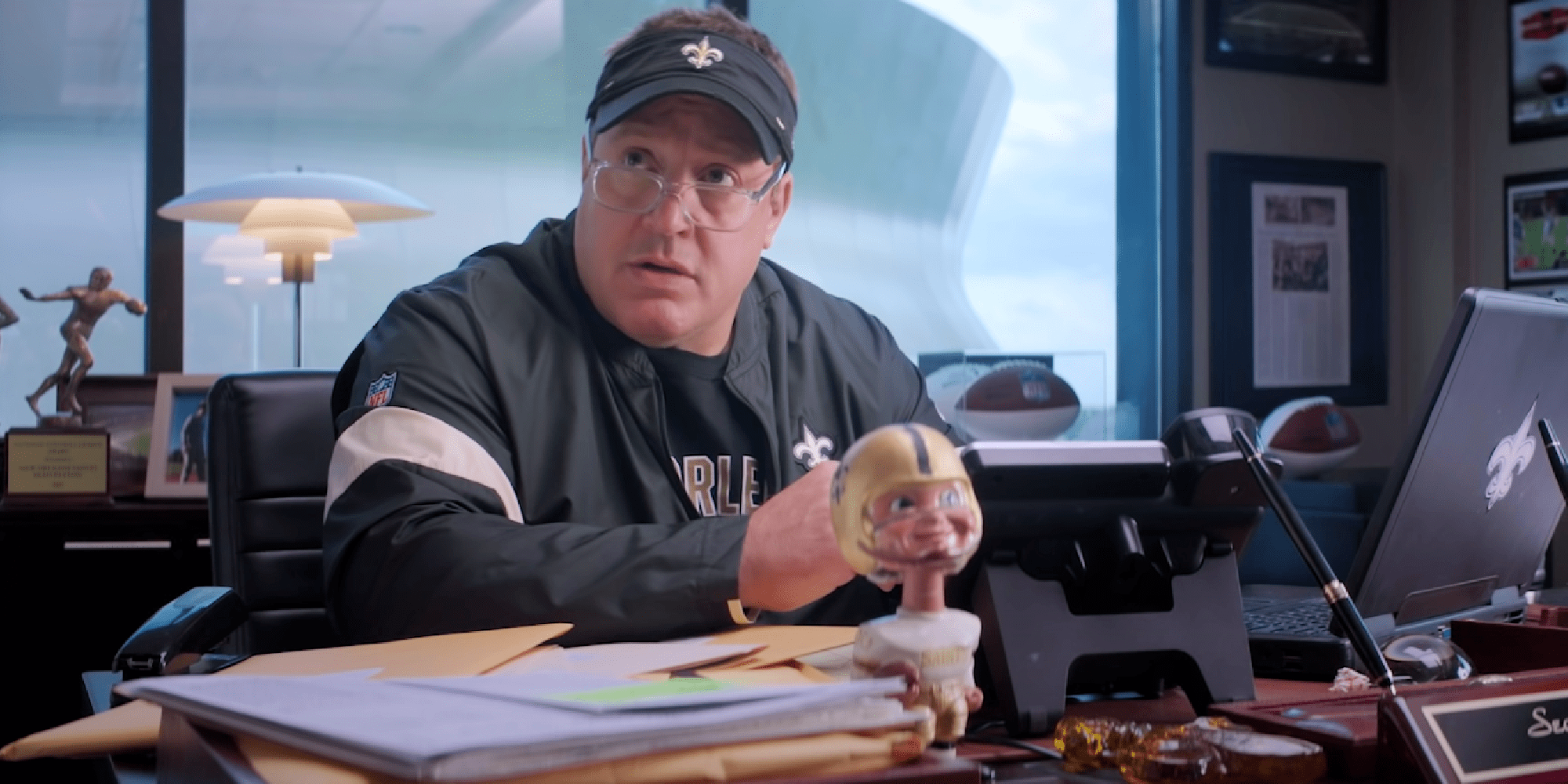
Super Bowl championship winning coach Sean Payton announced he was leaving his New Orleans Saints after 16 years with the franchise last week.
Just days after his decision, a brand-new Netflix film about a pivotal moment in Payton’s coaching career ironically debuted focusing on yet another time Payton was away from his Saints.
Home Team, a collaboration between Adam Sandler’s Happy Madison Productions and Netflix, is based on his life during the 2012 NFL season, where Payton was suspended by Commissioner Roger Goodell for an entire year due to a scandal where assistant coaches paid bounties to players for injuring their opponents.
The Kevin James-led film follows Payton back in his hometown of Argyle, Texas, where he helps a rag-tag middle school football team, including his young son Connor, turn around a losing season.
James is perhaps the most serious he has been in his entire filmography as Payton, a man struggling to find his identity without a job for a year while trying to reconnect with his son. James has truly funny comedic moments that come as natural extensions of the script rather than the comedian trying too hard to force the issue and over-power the punchline.
There’s a genuine warmth to his performance that endears the audience to Payton’s plight and helps build the foundation of an easy, yet enjoyable sports comedy.
Twilight star Taylor Lautner plays the team’s young head coach and while his performance is somewhat static and monotonous, it plays well opposite James and some of the more outgoing young stars on the team.
Because every football movie seems to require an alcoholic assistant coach, Gary Valentine stumbles through his lines physically and verbally as Mitch Bizone. For a PG-rated film, pre-teens may find Valentine’s performance comedic, but it truly comes across as ineffective and just slightly over-the-top.
Rob Schneider plays Payton’s ex-wife’s new husband, a vegan holistic teacher who serves no real purpose other than to make James seem more normal and relatable by comparison.
Directors Charles and Daniel Kinnane do their best to mimic classic sports films like The Bad News Bears and The Sandlot with their film and, at times, their direction evokes those films in a positive light.
But for the most part, Home Team suffers from the same overwrought sports cliches that plague so many movies in this genre and leans in a bit too much into the light-hearted, boisterous physical comedy prevalent in Sandler-produced films. There are several extraneous characters written into the screenplay from Chris Titone and Keith Blum that feel design just to elongate the film’s running time and Texas football fans will have issues with the timeline and season schedule represented for middle school teams in the movie.
As Netflix films go, Home Team is at best a middling feature not worth a look for adult cinephiles who haven’t poured through the studio’s extensive catalog of prestige films like The Power of the Dog and Tick, Tick, Boom. But for young moviegoers looking for something along the same lines as American Underdog that they can watch in the privacy of their homes, they could do far worse.

Robert Redford’s Sundance Film Festival has always been the premiere way for independent filmmakers to debut their work and kick off a full year of promotion to find an audience.
This year’s festival has gone digital due to the Omicron variant of COVID-19 preventing cinephiles from catching the best 2022 has to offer so far in person, but 2021 Sundance entries are making their way to general audiences.
Without question, the best film at last year’s festival comes from first-time writer/director Fran Kranz, who astonishingly crafts an intensely theatrical film plugged into current events and sure to tug at heart strings.
Mass has a simple through-line. Two couples meet in a church basement to discuss an unforgivable tragedy. One couple’s son murdered the other as part of a mass shooting at a local high school and as part of the intense healing process, both couples agree to meet to discuss their sons’ lives and grieve.
The four stars at the center of the film are expertly cast and all deliver remarkable performances worthy of making Mass the best ensemble film of the year and any of the four leads worthy of individual recognition.
Ann Dowd’s Linda shows remarkable perseverance and boundless empathy despite the emotional devastation of her son’s actions, perfectly balancing Reed Birney’s matter of fact melancholia as Richard, the father who felt incapable of helping his son.
Jason Isaacs covers Jay’s self-righteousness with a methodical, deliberate pursuit of understanding that borders on callous without completing crossing the line, while Martha Plimpton’s Gail expertly harbors anger mixed with profound sorrow without a real place to put either.
While the physical distance between the four actors feels wide in the intimately tight shots Kranz chooses, their emotional distance is even more pronounced, a testament to just how specific and nuanced each choice of gesture, emphasis of phrase, undercutting of dialogue is.
Birney and Dowd have an unspoken chasm between them as Richard and Linda still cannot fully comprehend the rationale of their son’s actions, which has driven a wedge in their marriage.
Jay and Gail have a much more supportive relationship that Isaacs and Plimpton timidly show in smaller moments of Mass, but each showcase how their pain manifests on an individual level that neither can truly console the other about.
Kranz’s near-flawless screenplay takes the proper amount of care to establish what needs to be explained to the audience while not spoon-feeding them everything like many dialogue-driven films feel compelled to do.
Tension and apprehension build slowly over the course of the first thirty minutes as the two couples prepare to meet and spend awkward early moments together.
The film’s cinematography is not obtrusive, but not overly simplistic either as Kranz and cinematographer Ryan Jackson-Healy press in on the actors’ faces as events unfold to hyper-focus on reactions and intimidate revelations. This works especially well with the extensive and much needed cross-cut editing style of Yang-Hua Hu, who balances the emotions of whoever is speaking with genuine reactions of those hearing them.
Visually, Mass begins mostly with the actors shown in pairs, capturing Jay and Gail supporting each other or Richard and Linda sharing stories in two-person frames. By the climax, however, Franz cuts the room down even further, keeping each actor secluded in their own frame to maximize the isolation each character feels and heighten the dramatic tension with rapid-fire cross cutting in a way that makes Mass more like a cinematic experience than just an exceptionally well filmed stage play.
For a film that takes place almost exclusively in a small room with four people seated around one table, the visuals and editing give Mass a larger-than-life aesthetic that pushes the audience into the fray of these conversations as if viewers are observing from just a foot or two away.
Every moment cinematically is considered carefully in choosing the focus, often keeping audiences hearing the words of a vulnerable Linda while staring into the heartbroken eyes of Gail or pressed into the snarl of Jay’s disgust as Richard describes ignorance of perceived warning signs.
If the camera panned wider or the script was done as a stage play, audiences would be so hyper-sensitive to watch the speaker that they would perpetually lose the masterful non-verbal reactive work, which becomes almost more important than Kranz’s words or the actors’ line delivery. The emotion comes from seeing the pain in an unflinching, closeup way that only cinema could provide.
A sure-fire winner at the Film Independent Spirit Awards, Mass also has somewhat of a chance to factor into this year’s Oscar race with Dowd’s performance seeming like the best opportunity to be recognized as a supporting actress if eligibility allows.
Now available to a wider audience, Mass is an absolute must-see film for cinephiles looking for a substantial drama sure to make an impact in the relative doldrums of January.
 Cinematic Considerations