Tag: Birdman

  • The Origins of Wit and Humor: Hill Country Film Festival spotlight

    The Origins of Wit and Humor: Hill Country Film Festival spotlight

    Good comedy is hard to find. Movies that consistently make us laugh without being formulaic and/or cliché are fewer and farther apart.

    Originality in the genre — whether it’s Oscar winners like “Birdman” and “Grand Budapest Hotel” or small independent efforts — should be equally celebrated.

    It’s thrust into this environment that Chicago-based filmmakers Christian Gridelli and Hunter Norris find themselves with their debut feature, “The Origins of Wit and Humor,” a multi-layered comedy playing at next weekend’s Hill Country Film Festival.

    Love of the craft

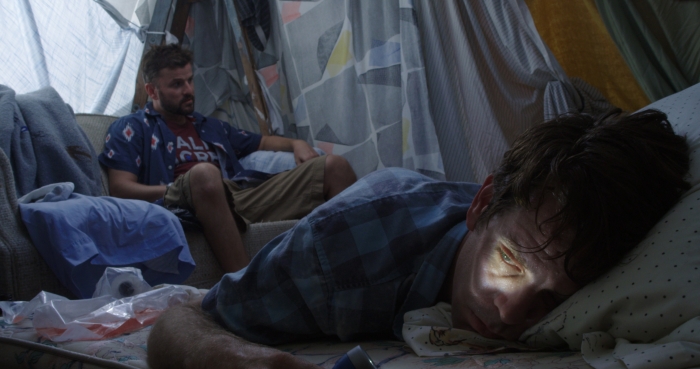
    At the film’s outset, the passion that Gridelli and Norris have for their craft shines through in the writing with a carefully-honed script pitting comedy writer Les (played by Joe Hursley) against himself as he battles with a need for validation while combatting loneliness following a breakup.

    “We’re both huge comedy nerds whether it’s comedy podcasts or films or reading stuff that is related to comedy or interviews with comedians,” Gridelli said. “We soak that stuff up, so it’s kind of been in our DNA for a long time, so that the way we view things at this point is through a comedic lens.”

    The film, which also stars “Super Troopers” alum Steve Lemme as Les’s best friend, Pops, is as much commentary on the comedy genre as it is a comedy in and of itself.

    Aside from the inciting incident of the film — the typical breakup scene — Gridelli and Norris turn from conventional comedy tropes, giving a solid effort with homages to the silent film era and many ’80s screwball comedies.

    “A big thing for us was — this is going to be our first feature — do you write it as you think maybe you can do a little easier or do you write a movie that you think you’d want to see,” Gridelli said. “Some of the more ambitious things we wanted to do with it were stuff we wanted to see. I can’t guarantee that we’ll have money, but I have faith that with our DIY aesthetic and background, that we could make it happen. Not just write ‘some good effort we can make it for the money we have’ movie, (instead) let’s make something that we would want to watch and be proud to have other people watch.”

    Value of the everyman

    “Origins” evokes numerous indie comedies of the past — from the obvious connections to “Super Troopers” with the casting of Lemme to the “UHF”-esque fantasy elements and fragmenting of the script. There’s also a subtle Woody Allen influence hiding in the film’s subtext as Les is one of the most authentic characters in a comedy in several years.

    Les “is a character that is super close to us,” Gridelli said. “In our minds the whole time it was that this is not about girl problems, it’s about problems with yourself.

    “Throughout this movie we just tried to make it really honest, you know? We tried to make at least the main character feel pretty honest, and I feel lucky
    having gone through this and being able to show it to people, they pointed out things that are definitely intentionally in there that I don’t know I necessarily tried to actively draw parallels with, I just tried to make them honest.”

    As viewers follow Les through his journey of self-redemption, the character remains relatable despite the outlandish things that happen to him following his decision to purchase a mail-order tonic that promises to make him irresistibly funny to women.

    “There was a Buster Keaton quote that a funny person does funny things and a comedian does things funny,” Norris said. “It’s weird too because this was a film where we tried to mine a lot of our own personal flaws as well to make a character that seems more believable. Then we’re like, ‘Okay this feels real,’ then we would have someone read the script and they were like ‘Oh, I like what an asshole he is.’”

    Developing the origins

    Like most Allen films, “Origins” is timeless in its construction, creating a world viewers are unable to contextualize in a specific period in time (i.e. no Zooey Deschanel jokes). It’s in the writing, which is incredibly nuanced, that the film is strongest, though it might take viewers several screenings to get all of the little bits that float throughout the film.

    “When we were younger, our process was always to come up with some stupid little joke that made us laugh so much that we just had to get it out there, so we would write a 10-page script around that. That was how our process worked when we were making shorts,” Norris said. “The lens through which we view the world is always a funny one. No matter what happens, we’re the types of people who are going to try and make a joke.”

    Perhaps the most ingenious part of the “Origins” script is to use the titular book that Pops gives Les — which includes the tonic order form — as a structure by which to frame the rest of the film. “Origins” moves chapter to chapter from Prologue to The Dead Frog in a way that combines seemingly unrelated topics — physical comedy versus humor at a wake.

    “That chapter structure actually came after the rough cut,” Norris said. “We were like, ‘Okay I think we need some room to breathe in here and what is a good way to do that that also thematically ties to the movie and that ties with our for lack of a better term, hero’s journey.’”

    “It also gave us a chance to flex a little bit on the title cards,” he added. “Those were really fun for us to do and I think that’s one of those things where our producers were like, that’s where I saw that DimeStore Films aesthetic besides the writing, obviously.”

    Becoming a reality

    The writing duo have spent most of their careers in short film work, starting the transition to features five years ago with the completion of a script that would eventually become “The Origins of Wit and Humor.”

    “When we approach the idea of a dream that becomes a reality and then becomes a nightmare, we’re going to look at it from how is this funny or how does this apply to funny things? So that’s what started off as a guy trying to make people not laugh at him, which to us seems like the craziest thing in the world,” Norris said. “Timing wise, it felt like we’re at the ripe old age of 24 and 25 and it was time for us to try and make a feature. Obviously that took a long time.”

    After getting production company Shatterglass Films to sign on for the project and a successful Kickstarter campaign, principle photography took place over a 17-day period in September 2013, a process Norris admitted “isn’t like making five short films all in a row.”

    Working with a larger team was also a new experience for the self-proclaimed DIYers of filmmaking.

    “Our background is to do all this stuff as sort of a two-man army,” Gridelli said. “In a way, (feature filmmaking) is a lot more liberating just because now we know all these talented people and we can break stuff up into departments, things like that allow you to feel a freedom to focus on directing and working.”

    “It’s a little hard to cede control to someone else is sort of until you can actually see oh they’re amazingly talented,” Norris agreed. “Then you can sleep at night instead of staying up until 4 a.m. looking up 800 bottles on Craigslist.”

    Attention to detail was a key part of the process for the “Origins” team as they attempted to translate a very conversational script into a dynamic feature film.

    “There are a lot of comedies out there right now that are sort of wordy like our script. It is a lot of shot, reverse shot and it’s not very interesting to look at,” Gridelli said. “But if you go back and look at some Woody Allen comedies, there’s always really nice composition going on in there and why can’t we do that with a wordy script?”

    More information on the film is available online at OWHFilm.com.

    (Note: Film critic Matt Ward is a programmer for the Hill Country Film Festival.)
  • What we talk about when we talk about Birdman

    What we talk about when we talk about Birdman

    It shouldn’t come as a total shock that “Birdman or (The Unexpected Virtue of Ignorance)” — a very inside acting film — would continue the trend of movies like “The Artist” and “Argo,” winning the Best Picture prize at Sunday’s Academy Awards.

    Now three of the last five films to win the most prestigious award in Hollywood are about Hollywood, actors or some combination of both, and that’s certain to upset a lot of members of the general public, whether they’re indie die-hards who were mystified by Richard Linklater’s 12-year filming odyssey “Boyhood” or patriotic Clint Eastwood backers supporting a box office smash hit in “American Sniper.” But when you watch or re-watch “Birdman” — now out on DVD and Bluray — it’s important to realize just how complete a film “Birdman” is and what exactly we should be talking about when we talk about “Birdman.”

    From the opening seconds, “Birdman” establishes itself as a film that’s going to draw moviegoers in with its visual brilliance, then keep them entranced with stunning performances from its deep and talented cast of actors.

    Newly crowned Best Director Alejandro González Iñárritu, whose previous films include “Babel” and “21 Grams,” provides the initial hook, opting to stage the film in narrow, tight hallways inside the backstage of the St. James Theater in New York City to provide added tension, then flipping cinematic standard on its head by fusing each scene together so that “Birdman” feels like one never-ending, 120-minute shot.

    Each scene is stitched together seamlessly thanks to the artistic savvy of “Gravity” cinematographer Emmanuel Lubezki — recent winner of back-to-back cinematography Oscars — and editors Douglas Crise and Stephen Mirrione.

    Each scene transitions to the next without interruption, mostly done through extended segments of 10 minutes or more. The necessary technique to pull off such a terrific stunt is a beautifully choreographed dance between actors and crew.

    A great deal of technical care has been taken in the movie, which rivals “Gravity” as the most forward-thinking and visually dynamic film in years.

    This sort of digital skill is becoming commonplace — especially in the superhero film genre “Birdman” constantly derides — but never with such grace. It’s a breath of fresh air to see the technical wizardry of a film accent highly skilled and complete acting performances, rather than having gimmicks or special effects operate as a replacement for quality acting.

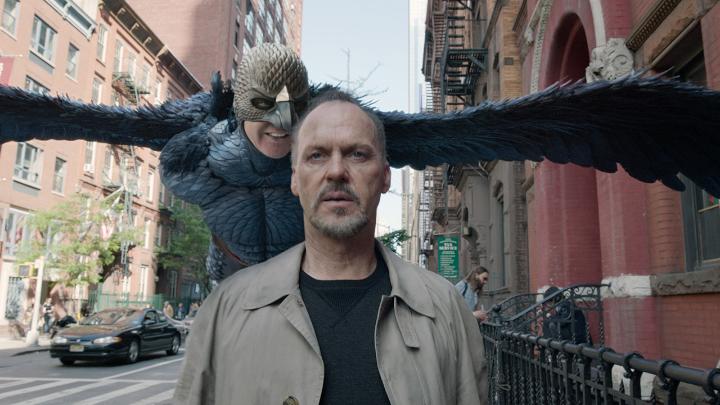
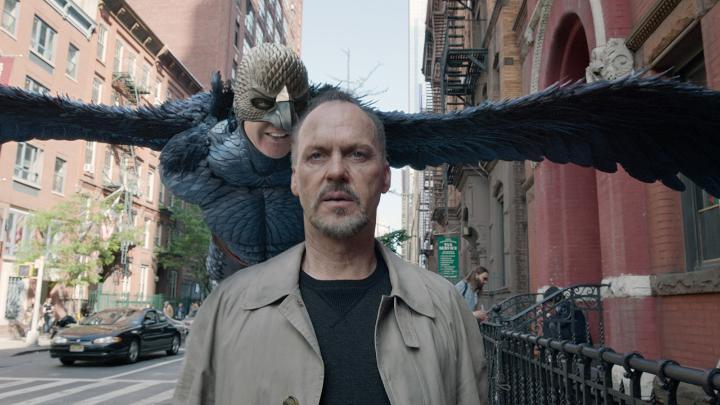
    Much in the same way that David Fincher used who Ben Affleck is as a public figure to great effect in “Gone Girl,” Iñárritu’s choice of former “Batman” star Michael Keaton as the titular “Birdman,” given Keaton’s struggles to overcome the shadow of his role as Batman parallel his character Riggan’s difficulty separating himself mentally from the super hero character Birdman that made him a movie star 20 years ago.

    As a moviegoer, it’s nearly impossible to completely separate Keaton, the actor, with Riggan the character and in the case of “Birdman,” the film takes full advantage of this duality to create a deeply personal and emotionally rich character wanting to prove himself to the world while mistaking adoration for love.

    Keaton, who narrowly lost out to “Theory of Everything” star Eddie Redmayne for a Best Actor Oscar, gives the performance of a lifetime in the role, which ironically enough, should redefine Keaton as a passionate actor outside of the comic book realm.

    Edward Norton, who would have won Best Supporting Actor in a year where J.K. Simmons didn’t blow people away in “Whiplash,” provides Keaton with a sounding board to lob emotional volleys to, both in the film itself and in the Broadway stage show Riggan is producing, an adaptation of the Raymond Carver short story, “What We Talk About When We Talk About Love.”

    Emma Stone — who is slowly, but surely proving herself to be something much more than the limited characters she’s been playing on screen — makes the absolute most out of every second in her performance as Keaton’s drug-addled daughter looking to stay clean while helping her dad reform his own image. The subtle co-dependence the two characters share in their mutual rehabilitation is one of the many great sub-plots in an intricately woven tale.

    Outside of “The Grand Budapest Hotel,” moviegoers would be hard pressed to find such quality acting from so many talented performers — Naomi Watts, Zach Galifianakis, Amy Ryan, Andrea Riseborough.

    But the question still remains: What do we talk about when we talk about “Birdman?”

    How do you explain a meta, highly self-referential dramedy that seems to demean its audience by lavishly deriding the common blockbuster experience?

    Quite simply, “Birdman” is the next step forward in a cinematic evolution that began with James Cameron’s visually transformative “Avatar” and continued with Guillermo del Toro’s space adventure “Gravity.”

    Adding new depth in acting to lofty and innovative cinematography makes “Birdman” the obvious next step in filmmaking, led by Iñárritu, who is up to the task of making all the moving pieces work fluidly and beautifully.

    “Birdman” checks off on all the critical elements of a complete cinematic experience — visual brilliance, acting talent giving top notch performances, elite technical skill and a blue-chip script — and is worthy of its Best Picture statue.

  • Birdman (or the Unexpected Virtue of Ignorance): Keaton shines in superhero actor rebound

    Birdman (or the Unexpected Virtue of Ignorance): Keaton shines in superhero actor rebound

    It isn’t quite fair to say Michael Keaton is back thanks to his often brilliant performance in “Birdman (or The Unexpected Virtue of Ignorance) because, despite his long absence, Keaton has never performed at this high a level.

    Fact melds well with fiction as Keaton’s struggles to overcome the shadow of his role as Batman parallel his character Riggan’s difficulty separating himself mentally from the super hero character Birdman that made him a movie star 20 years ago.

    The angst Riggan feels throughout the film is identifiable for the viewer because of Keaton’s presence on screen. George Clooney and Matt Damon cannot make that kind of connection with the audience because of how personal the role feels for Keaton.

    Though Keaton is tremendous in a role clearly built for him, he’s not the reason to see perhaps the most innovative film in 2014.

    Director Alejandro González Iñárritu, best known for “21 Grams” and “Babel,” has plotted an intense thriller schemed as a black comedy through the use of extended one-take camera shots that leave the viewer wondering how in the world filmmakers pulled it off.

    Well-pulled off digital trickery as well as creative camera and editing work make “Birdman” feel like one continuous long take with seamless transitions from one scene to the next.

    “Birdman” also boasts a terrific supporting cast, including Emma Stone as Keaton’s recovering addict daughter, a calm Zach Galifianakis as Keaton’s best friend and lawyer and Oscar nominee Amy Ryan as Keaton’s ex-wife.

    All give quality performances, but pale in comparison to the tour de force effort from Edward Norton who provides the perfect foil as Keaton’s acting partner.

    It’s going to be difficult for “Birdman” to find wide mainstream appeal as its highly complex psychology and frantic cinematic style won’t resonate with a larger percentage of audiences.

    It doesn’t help that the film lambasts these same viewers in its not-so-subtle critique of the Hollywood superhero film genre.

    “Birdman” seeks out more sophisticated viewers — the kind who prefer a dramatic Broadway play to “Iron Man 3” — and makes no bones about the latter being a lesser form of art.

    Viewers need to appreciate “Birdman” for the artwork and not necessarily the message if they want to enjoy one of the year’s most innovative pieces of filmmaking.