Category: Oscar Contenders

Oscar contenders, awards-season coverage, awards predictions, nominations, and ceremony analysis. Historical archive category retained at its original URL; use selectively for awards-relevant articles.

  • The Banshees of Inisherin: The charm of simple storytelling

    The Banshees of Inisherin: The charm of simple storytelling

    So often movies must have big, grandiose stakes in order to appease a wide audience.

    They have global, if not universal consequences to the world filmmakers create, require massive budgets, large casts, intricate sets and visual effects to become cinematic blockbusters worthy of the big screen.

    The scale to which the average movie has expanded has drastically altered the landscape of modern filmmaking and when more intimate portraits of simplicity are crafted by experts with unique vision and care, this exceedingly rare achievement deserves to be shown to as wide an audience as possible to remind moviegoers that not every movie must be an epic tale.

    Such is the case with Academy Award winner Martin McDonagh’s latest feature, perhaps the simplest of his four films that examines a low-stakes story between two men with a relatively minor grievance and allows it to play out naturally and fluidly over the course of 100 minutes.

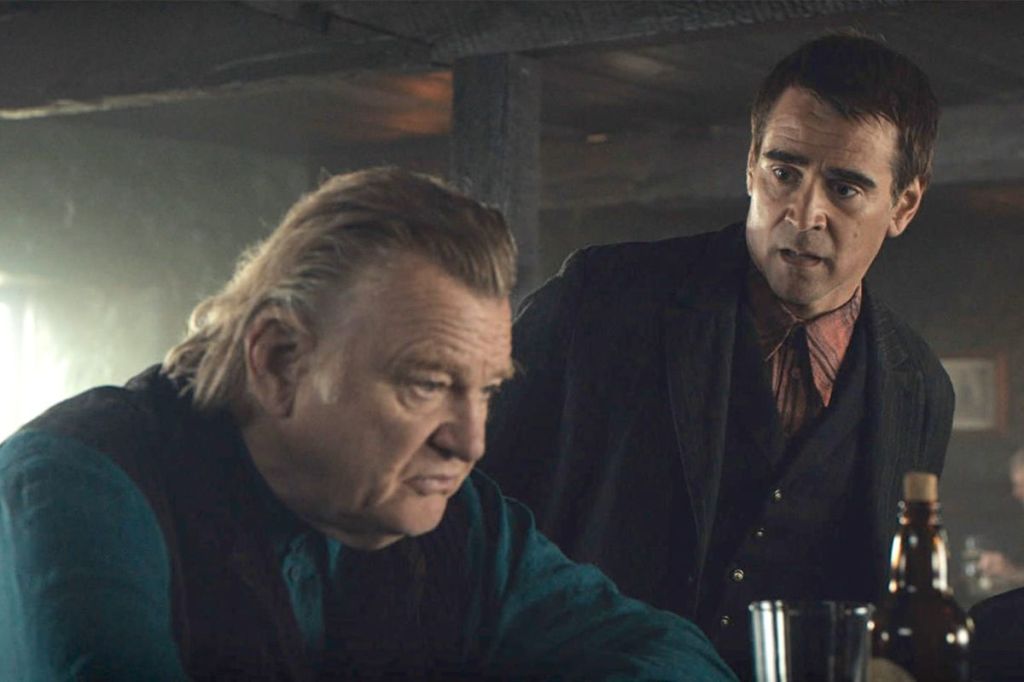
    Set on a remote island off the coast of Ireland, The Banshees of Inisherin follows long-time friends Pádraic and Colm at a crossroads when Pádraic goes to Colm’s house to invite him to the local pub only to realize that Colm no longer wants to be friends or even speak to him ever again.

    Because of the stakes of Banshees are so small, there’s a lot of time for McDonagh and his cast to unpack the seemingly simple act of ending friendship and expand the depths to a scale more befitting of a stage play rather than theatrical cinema. 

    Banshees is McDonagh’s most composed and focused as a screenwriter, with a tightly constructed world that focuses on dialogue rather than bombastic violence like his Oscar-winning Three Billboards Outside Ebbing, Missouri or the audacious Seven Psychopaths. It’s also McDonagh at his strongest in the director’s chair as he commands the camera with an assuredness he hasn’t completely shown before as a filmmaker.

    But it’s clear from the outset that McDonagh’s vision for Banshees is closely woven in with the actors he wrote the film for, reteaming him with his In Bruges stars Colin Farrell and Brendan Gleeson.

    As Pádraig, Farrell takes a rather bland character and invigorates him with more heart than any performance in the talented Irish actor’s career. Farrell portrays Pádraig as charmingly simple and it never feels like Farrell rushes through the moment or overly considers Pádraig’s thoughts, rather the simplicity comes as a natural extension of Farrell’s connection to the character.

    This is especially true when it comes to Pádraig’s devotion to Colm, where the emotional bond between Farrell and Gleeson seeps over into their characters as it would normally resonate better in a stage play. The genuine affection the two have for each other radiates off the screen even as the plot drives Pádraig and Colm further apart.

    Gleeson, though clearly in support, also more than holds his own through a stoic gruffness that keeps viewers on the edge of their seats wondering what Colm’s true motivations are and whether he’ll live up to his words.

    The secondary characters of Banshees, especially Kerry Condon as Pádraig’s sister and Barry Keoghan as the town simpleton, help provide color to the vibrant world McDonagh creates in such a small setting.

    One of the most entertaining elements in Banshees are the ways in which McDonagh utilizes animals as supporting characters, whether it be the emotional connection between Pádraig and his donkey Jenny or a particularly funny exchange between Colm and his dog.

    The film is visually arresting without being distracting from the overall narrative and cinematographer Ben Davis does a remarkable job in both framing and especially lighting Banshees in interesting and engaging ways. This is particularly true in how the town pub is lit and the care used to frame cast members in limited natural lighting.

    Banshees has strong potential to be a major contender this awards season with the film being almost a lock for a Best Picture nomination and McDonagh’s screenplay as well as Farrell’s lead performance likely to receive considerations. It also could easily land in cinematography and score categories as well as propel Gleeson into a supporting actor nod if the film overperforms.

    Sure to be one of the year’s most acclaimed and well-received films, The Banshees of Inisherin deserves a much wider audience than its current limited release and is well worth ardent cinephiles seeking out in theaters.
  • Tár: Measures of time

    Tár: Measures of time

    Time is a very precious and valuable thing.

    What we do with our time, how quickly or slowly life seems to go all feels set at a tempo that we conduct ourselves.

    It’s also at the core of acclaimed writer/director Todd Field’s first film in 16 years, a cerebral, cold, elongated portrait of a woman convinced that she has mastered time itself.

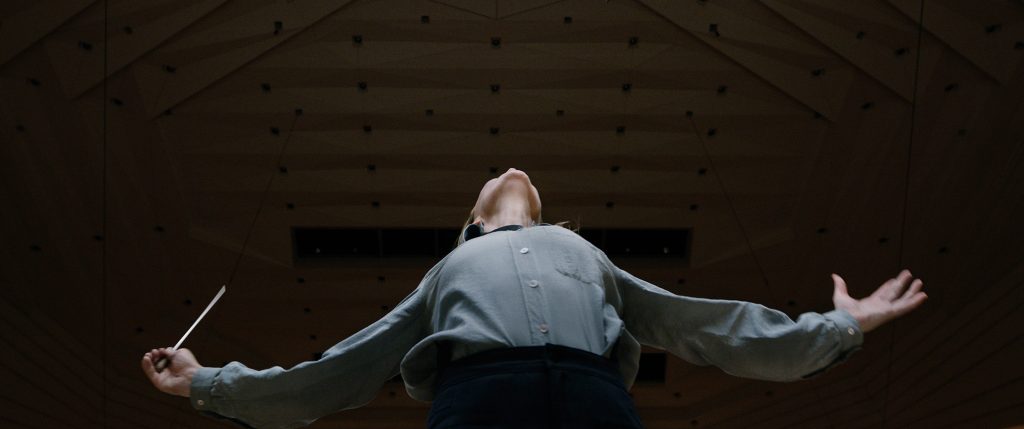
    Featuring one of the year’s most compelling performances from two-time Academy Award winner Cate Blanchett, Tár follows the titular character Lydia Tár, head conductor of the Berlin Symphony Orchestra at the top of her game preparing to achieve the pinnacle of her career when whispers of something darker begin to pervade her life and psychologically terrorize her.

    It’s important to note at the outset that Tár takes its time crafting a world rather than developing a quick, speedy plot for audiences to follow. Field is not entirely concerned with how long scenes take to develop. There are numerous extended tracking shots that cover large portions, if not entire scenes, that while beautiful, elongate Tár to a languishing pace.

    The same is true of Blanchett’s Lydia, a character so demonstrably in control that time is of no great concern to her. Every action, every physical flinch, movement, stroke of her hand is measured beyond all consideration to the point where Lydia truly believes she domineers over time.

    It’s an interesting and engaging way to approach a character and it would completely fail in the hands of anyone other than Blanchett, an actress so cerebral in her performance that viewers can easily see the wheels turning in Lydia’s head even as things begin to spiral out of control.

    Her work is especially compelling in the first act as Blanchett can chew up all the scenery around her and Lydia’s guest lecture at a Juilliard master class will certainly be one of the five best scenes in cinema this year.

    Although Blanchett rightfully dominates every moment in Tár as audiences never leave Lydia’s point of view for more than an instant, the supporting cast is exceptional in their own right, especially Nina Hoss as Lydia’s partner and a member of her orchestra and a fantastically frustrated demure turn from Portrait of a Lady on Fire star Noémie Merlant as Lydia’s assistant Francesca.

    Thanks to Field’s creative vision and Blanchett’s singular performance, Tár is so specific in its world-building and nuanced in detail that it feels as if Lydia is a real person and that Tár is a dramatic biopic in the vein of Pablo Larrain’s Spencer.

    This truly extends throughout the craft with exceptionally cinematic visuals that feel ripped out of a European museum shot by director of photography Florian Hoffmeister and a measured, yet often roaring score from Oscar winning composer Hildur Guônadóttir that blends the work of Gustav Mahler with sounds haunting Lydia’s mind.

    For as much as Tár prides itself and references time as a main theme of the film, editing is by far the weakest element of the film with a painfully slow pace dragging down the quality of the drama in the film’s back half and really making audiences feel the weight of its nearly three-hour running time.

    While it’s still unclear just how well received Tár will be this awards season, Blanchett is undoubtedly the frontrunner to win her third acting Oscar and the film could easily ride her coattails with nominations for Hoss in supporting actress, Field in direction and Hoffmeister in cinematography.

    The best chance for audiences to enjoy Tár is through an immersive cinematic experience on the big screen that requires viewers to maintain constant attention to what’s happening and allow the visual and auditory brilliance to play out. Unfortunately, for those unable to do so, it’s unlikely that at home viewing at a later date would keep viewers from fully investing in Tár. 

  • Blonde: Cracks below the surface

    Blonde: Cracks below the surface

    The human mind is a fragile thing.

    For as much as we want to believe that we are capable of handling anything that life throws our way, it’s the trauma and mental anguish that goes untreated that often leads to our demise.

    This is very much at the core of writer/director Andrew Dominik’s latest film, an avant-garde fever dream odyssey that follows no rigid plot structure nor overly glamorizes or demonizes its protagonist.

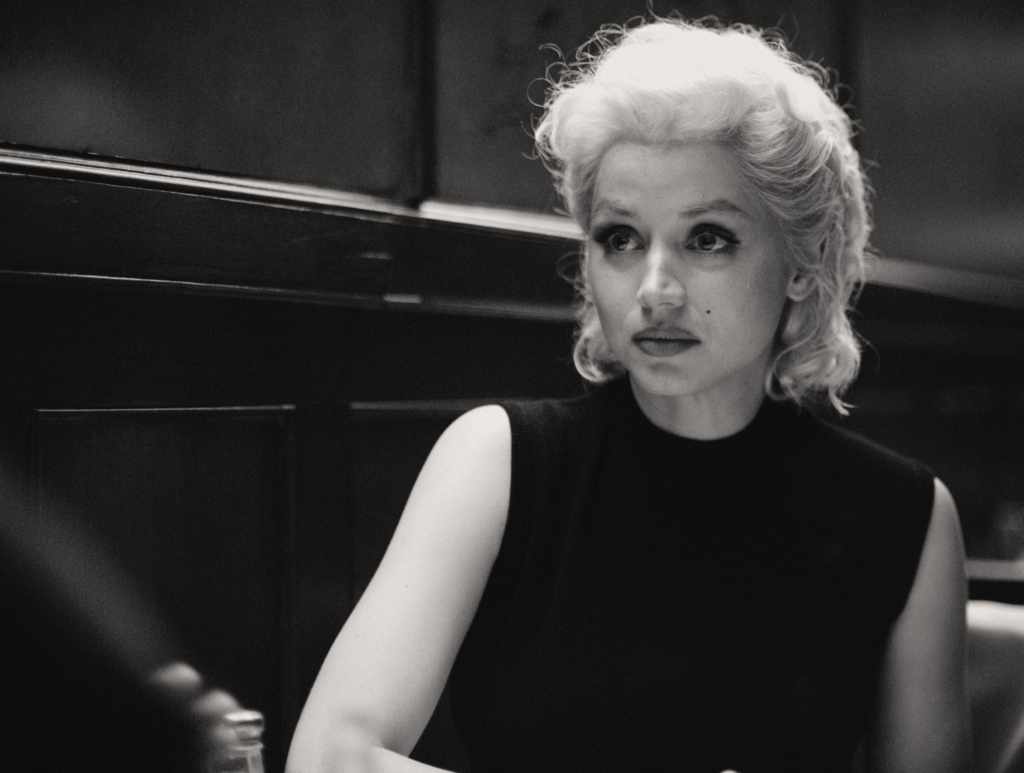
    Based on the fictional novel by Joyce Carol Oates, Blonde isn’t a traditional biopic, although it loosely follows the life of Norma Jean Mortenson, better known to the world as film star and pop culture icon Marilyn Monroe.

    Viewers see Marilyn’s childhood, her rise to stardom and relationships, but what’s most important to Dominik is the emotional toll that Marilyn’s journey takes on her and how the inner conflict between Marilyn the star and Norma Jean the real person comes to affect the tragic deterioration of her mental health.

    In a lot of ways, Blonde is very reminiscent of Pablo Larrain’s Spencer, an equally manic psychological drama from 2021 focusing on the stress and mental anguish of fame through the eyes of Princess Diana, although Larrain has a clearer narrative structure to his film and Dominik widens his gaze to a more ethereal, scattershot approach to hit the highlights of a much longer period.

    Up-and-coming actress Ana de Armas astonishes as Marilyn in a performance that’s elegant when it needs to be but constantly in a state of unease and brittle to the point of cracking. It’s clear to see the pain hidden with Marilyn’s eyes as de Armas radiates the hurt while simultaneously attempting to hide it behind a bubbly demeanor and infectious smile that captivates the hearts of millions.

    Dominik and de Armas aren’t necessarily interested in capturing who Marilyn was from a biographical perspective, more examining larger themes, and an overwhelming sense of longing for the father she never knew and the mother taken from her by mental illness.

    Her performance is constantly on a razor’s edge and de Armas brings out the best in a less nuanced role but doesn’t make Monroe a caricature. 

    A lot can be said of the sexuality within Blonde given the film’s NC-17 rating. While it’s true that de Armas spends a considerable amount of time topless, this is more an effect of her fragility in emotional and mental state rather than pure exploitation on Dominik’s part as a director. 

    The brutality of two specific scenes where Marilyn is essentially raped are less demonstrative in their sexuality but feel exceptionally explicit given the helplessness Marilyn feels in each scene and help to further the deterioration of Marilyn’s state of mind.

    Much of the supporting cast floats in and out of Blonde while the focus remains almost exclusively on de Armas.

    Blonde astonishes with its picturesque, complex cinematography from director of photography Chayse Irvin, who with Dominik essentially recreates iconic Monroe still photographs as full layered scenes that float effortlessly between an assortment of aspect ratios as well as in and out of color.

    But the consistency in quality of filmmaking on a frame-to-frame basis never wavers. Blonde is an exceptionally stunning film regardless of what era or visual approach Dominik and his production team choose for any given moment and viewers are always firmly planted in Marilyn’s world visually.

    For a film that runs at nearly three hours, it’s exceptionally well edited – especially transitioning from scene to scene in combination with the visual elements – and although the audience will easily feel the totality of the run time, it’s hard to look away from de Armas’s singular performance.

    There aren’t really any Oscar prospects for Blonde despite its limited theatrical release. The film’s NC-17 rating combined with other more mainstream options on Netflix’s slate will make it unlikely that this controversial drama will make the shortlist for even the most liberal of awards voters despite deserving acclaim in lead actress, cinematography, and score.

    Blonde is a film for few very forgiving cinephiles as many audiences will scorn Monroe’s depiction although de Armas gives the most compelling performance as Marilyn. It’s a more captivating movie on the big screen than it will likely be on Netflix, but the ease of access should broaden the range of viewers who can compartmentalize Blonde into more manageable chunks.

  • Don’t Worry Darling: Down the rabbit hole

    Don’t Worry Darling: Down the rabbit hole


    There’s a fantastic film hiding somewhere deep within Don’t Worry Darling, Olivia Wilde’s follow-up to her surprise hit directorial debut in 2019 with “Booksmart.”

    In an idyllic world, Darling takes an incredible Florence Pugh performance and elevates it with exceptional cinematography and production design as well as an ensemble cast that can help create a larger world and bring an intriguing concept to life.

    The building blocks for a top-five movie of the year are there, but nothing ever really comes together in Darling, a big swing and largely hit-or-miss drama that doesn’t settle on a proper tone nor truly lets the audience in on what’s going on.

    Darling follows Pugh as 1950s suburban housewife Aliceliving out a life of relative luxury in a corporate based community ripped straight out of a mid-20th-century American dream. It’s only when Alice learns that there’s something much darker behind the bright façade that her life begins to spiral.

    The centerpiece of the film, Pugh is exceptional at keeping this fledgling genre-bending drama afloat with a subtly manic performance that leaves audiences constantly questioning if Alice is the crazy one or if everyone around her is.

    As is often the case with her work, Pugh dances around any other actor she’s on screen with and it’s clear on a scene-to-scene basis that her Alice isn’t like anyone else in the film, nor is her performance on the same level as anyone else. It’s a magnetic turn from a brilliant actress that allows the increasingly confusing, bizarre narrative to take shape while keeping viewers interested.

    Pugh being a class above everyone else in Darling is especially true in the wide gap between her work and that of musician Harry Styles cast as Alice’s husband Jack. Their romantic chemistry is increasingly visual through tight camerawork and an emphasis on the physicality of their love.

    But whether it’s the screenplay by Katie Silberman or Styles’ inability to emote or some combination therein, there’s a tone-deafness to their marriage that’s much deeper than Wilde or the script might want to imply.

    The larger ensemble cast does well with what they are given for the most part.

    Chris Pine continues to showcase his ability to be a more well-rounded actor as the Svengali-esque leader of the Victory community. It’s a performance that’s part William Shatner, part Dr. Oz, part Jordan Belfort but always engaging and challenging the audience’s expectations.

    Wilde does a solid job of creating mystery behind Pine’s character visually, largely keeping him in the shadows ever lurking but a firm presence for much of Darling.

    Where it often seems like Wilde doesn’t have as strong of a grasp is in the supporting female performances in the film, which highly evoke a Stepford Wives vibe but just doesn’t fully click.

    It’s problematic that the only African American actress in the film, KiKi Layne, is burdened with a role that accentuates white savior tropes and doesn’t showcase how dynamic of a performer she truly is, but Layne excels at breaking the walls down in an emotional and frantic way.

    Darling boasts some of the most engaging cinematography of the year with director of photography Matthew Libatiqueenveloping the world of Victory with a bright glossy sheen that starts to wear off as the plot unfolds. Darling needs to look perfect in the beginning and progressively become an uglierplace and Libatique becomes a secondary star with a constantly moving camera that spirals and encircles Alice to heighten the tension and Pugh’s magnetic performance.

    It’s nearly impossible to experience Darling objectively given the lengthy behind-the-scenes drama involving several lead actors and the director, which is a shame given how strong much of the film is. Only the third act truly falters and it’s in the final moments where all the goodwill and momentum Wilde and Pugh have built over the course of 70 minutes comes crashing down.

    A Hollywood blockbuster that is meant to be seen on the big screen, Don’t Worry Darling has enough highs to be enjoyable for much of its running time from a magnetic Florence Pugh to exceptional cinematography and production design that make it a movie worth checking out in theaters.

  • Elvis: All shook up

    Elvis: All shook up

    When a film is titled after one of its characters, 99 times out of 100, that movie is almost entirely about that person. (Save for Private Ryan, of course.)

    This is even more true when it comes to biopics, especially when the titular character happens to be one of the most iconic musicians of all time, the King of Rock and Roll himself.

    But writer/director Baz Luhrmann’s epic, nearly three-hour depiction of Elvis Presley, simply titled Elvis, is only half about the musical legend. There’s a character hiding in the shadows behind the pomp and circumstance that Luhrmann forces into center stage, often pushing Presley to the side for his own redemption and glory.

    Much of the rise and fall of Presley is told from the perspective – and often through languishing narration – by his carnival barker-esque manager Colonel Tom Parker to the point where Luhrmann’s overall message about exploitation for profit gets muddled.

    It feels unfair to begin a discussion of an Elvis Presley biopic by talking about something other than the man himself because of his irreversible impact on generations of popular culture, music, and American history, but it’s exactly the position Luhrmann wants to take with his film.

    Elvis isn’t about Elvis.

    At least not entirely.

    Oscar winner Tom Hanks turns in his most baffling performance in years as Parker, waffling through a waning, vaguely European accent that feels more like caricature than imitation. Hanks wades frequently into the waters of the conman grifter, then uses his natural charisma to try and charm audiences back in as Parker continues to pull the wool over Presley’s eyes.

    It’s a very broad, showy performance that’s audacious and self-congratulatory in a film where audiences are looking for the focus to be elsewhere.

    And this isn’t to say that Luhrmann is pushing Hanks to the forefront because the up-and-coming actor playing Presley isn’t worthy of the spotlight. The complete opposite is true.

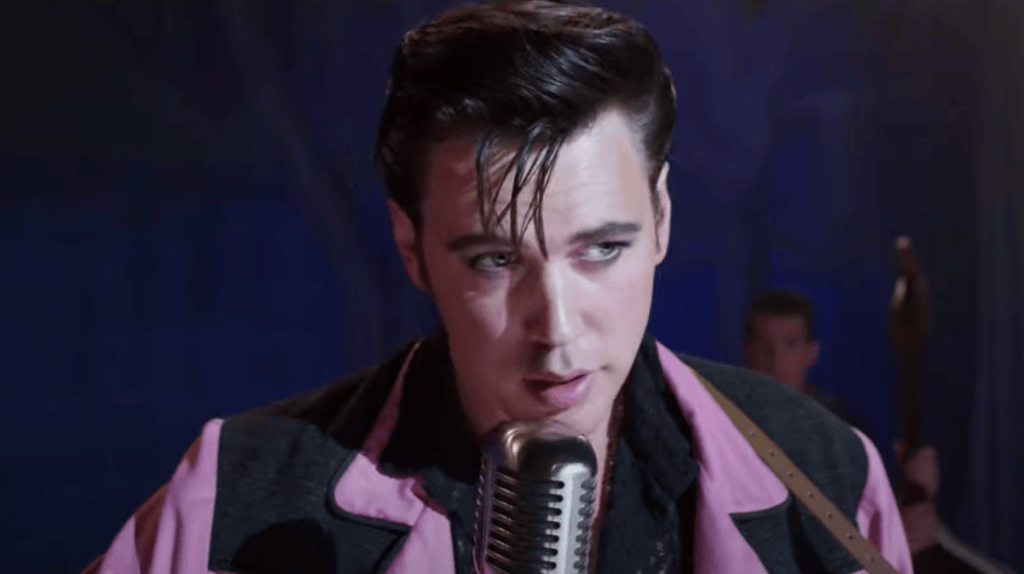
    If Elvis is worthy of consideration for awards in any respect, Austin Butler’s magnetic, almost hypnotic transformation into the man who would become King of Rock and Roll certainly deserves all the praise he will likely get for the next six months.

    It isn’t just that Butler sounds like Presley to the point where viewers with their eyes closes couldn’t tell the difference between the real thing and the copy. It’s also not just because expert craftspeople in the makeup and costume departments take a young actor who looks like Presley and perfectly accentuate his look to maximize the effect.

    Butler’s physicality, relentless energy, and emotional core transport audiences into everything that is and was Elvis Presley. Concert sequences evolve along with Presley’s musical style because Butler can slowly, then more brazenly contort his body and gyrate to make viewers young and old swoon.

    It’s also the way Butler’s able to lift the entire film by connecting with Presley’s heart in such a way that the more tender, emotional moments feel genuine and contrast the bombastic nature of the swirling film around it.

    Never one to shy away from audacious cinematography or excessive editing, Luhrmann keeps Elvis at a rigorous pace that has audiences on their toes for much of the run time and it’s only in the final act that the 159-minute feature burdens viewers with the weight of it all. There’s so much going on that often overshadows the brilliant work that Butler is doing in the title role that keeps Luhrmann’s film from being great, or at times even watchable.

    But there are other moments, often in concert sequences or the terrific filming of Presley’s 1968 television special meant to be a Christmas ad concert for Singer sewing machines, where Elvis really shines and has Presley’s signature larger than life attitude.

    The bloated runtime, excess focus on Parker and the uneven tone of Luhrmann’s extravagance makes Elvis cumbersome to engage with as an audience and this isn’t even to speak of the film’s option not to address Presley’s political and societal implications outside of entertainment.

    For ardent Presley fans and those who love Luhrmann’s more avantgarde filmography like Moulin Rouge and The Great Gatsby, Elvis might be worth taking a chance on in theaters. More casual audiences should probably wait until it hits at home rental or streaming services to break the film up into smaller, more manageable chunks.

  • Cha Cha Real Smooth: All the right moves

    Cha Cha Real Smooth: All the right moves

    The best movie characters, ones audiences take to and see themselves in, aren’t always idyllic.

    Filmmakers find genuine beauty in flaws and imperfections in their personalities and psyches that allows viewers to naturally respond and become more fully transported into another world.

    Cooper Raiff’s second feature film – an audience award winner earlier this year at the Sundance Film Festival – screened this past week at the Tribeca Festival before debuting in select theaters and Apple TV+ on Friday.

    The Dallas native wrote, directed and stars in Cha Cha Real Smooth, featuring Raiff as Andrew, a down on his luck recent college graduate working as a Bar Mitzvah party host who befriends an isolated mother and her autistic daughter. It’s a film with boundless heart, flawed characters who don’t always do the right thing and an unflinching, un-fakeable authenticity.

    Cha Cha Real Smooth feels more genuine and honest about personal flaws than any coming-of-age dramedy since 2017’s Lady Bird and there’s a sentimentality to Raiff’s screenplay and direction that seeps into every crevasse of the film to tug at viewers’ heartstrings at the perfect moments.

    Raiff portrays Andrew with an unbridled passion for life that he just can’t seem to control. His work shows Andrew as a man who wants to be great but has no idea who he is or wants to be come and there’s a frantic energy to every interaction Andrew has in Cha Cha Real Smooth that reflects Andrew’s longing for a real life to start.

    There’s a distinct feeling viewers get watching the film that Andrew (as well as Raiff as a filmmaker) cares so deeply about almost every character that he will do whatever it takes to make others as happy as he wants to be himself. The sentimentality of that notion shines through in Raiff’s performance and drives much of Andrew’s motivations.

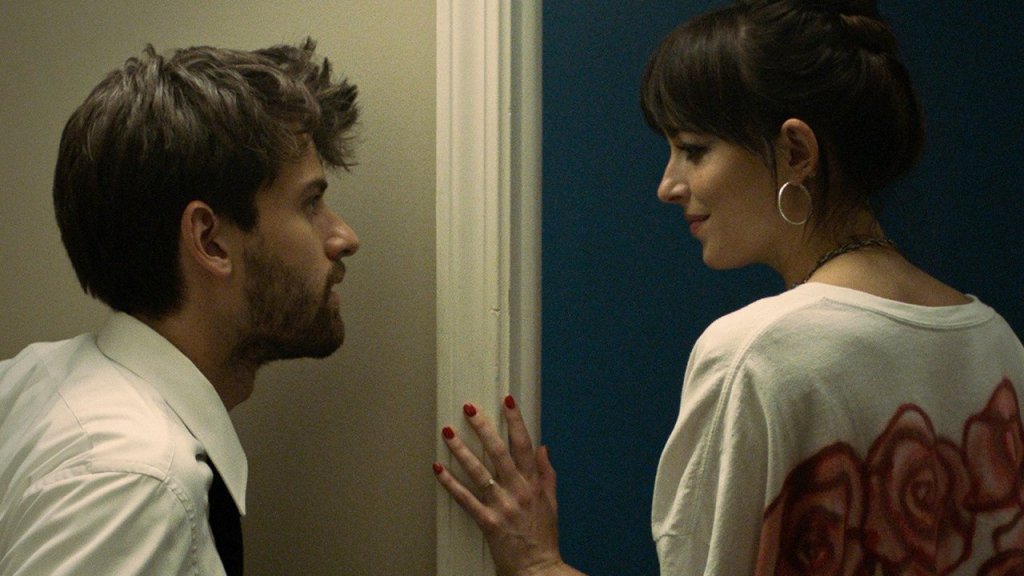
    Raiff’s work is perfectly counterbalanced in the film by Dakota Johnson’s more free-spirited, yet melancholic turn as Domino, a young mother of an autistic teen whose life hasn’t gone the way she probably wanted. The duo creates a chemistry between Andrew and Domino that has a magnetic push and pull of emotional infatuation rather than true romantic connection.

    Both Andrew and Domino make decisions in the film that audiences may cringe at, but Cha Cha Real Smooth approaches it through Raiff’s screenplay in such a way that there aren’t really any judgments, rather an appreciation for the complexity of real life.

    Every performance in Smooth has to work perfectly for Raiff’s script to shine as much as it does and the acting across the board is nothing short of pitch perfect.

    The film’s young actors should be stealing the show, but Raiff and Johnson have a distinct and palpable energy to their chemistry that takes Smooth to another stratosphere.

    Newcomer Vanessa Burghardt is heart-melting as Domino’s daughter, Lola, and there’s a winning charm to her interactions with Andrew as she warms up to his presence in her life that the entire movie could have been built around.

    Evan Assante’s bond with Raiff as Andrew’s tween brother David and the instantaneous love felt for Andrew’s relationship with Leslie Mann’s turn as his mother allows audiences to warm up to Andrew in a more well-rounded way, showing his inherent sweetness on a familial level as much as an idyllic romantic level.

    As a director, Raiff gives his film a very distinct vibe by often turning up the color contrast to deepen the shadows and highlight the bright colors, which especially work wonders during night scenes and the frequent party sequences of the film. It’s as if the visuals match the frantic energy racing through Andrew’s head.

    Cha Cha Real Smooth deserves to be a major awards contender later this year, especially Raiff’s wholly original screenplay and Johnson’s magnetic supporting performance. The one downfall, however, may be Apple’s focus on the much more star-studded upcoming Martin Scorsese film Killers of the Flower Moon that may pull voters’ eyeballs away from a smaller, more intimate movie.

    Raiff’s second feature film will be a crowd favorite worth heading to theaters to revel in the humor and emotion with others, though its ease of access on Apple TV+ helps ensure Cha Cha Real Smooth becomes an instant hit with an even larger audience than a normal independent dramedy might.

  • Top Gun Maverick: Cruising at higher altitudes

    Top Gun Maverick: Cruising at higher altitudes

    There’s a moment early in Tom Cruise’s first film in four years where his character must lay everything on the line and push himself beyond all the limits to save his team.

    It’s a constant theme in the nearly 60-year-old actor’s latter career as Cruise constantly strives to top himself for the sake of blockbuster cinema, attempting to save theatrical releases by dangling from tall buildings, freefalling from heights unfathomable by anyone who isn’t a stuntman and literally flying fighter jets to show his face in the cockpit at Mach speeds.

    Cruise’s endless bravado – a seemingly equal balance of boyish charisma and belief in his own invincibility – propels every choice he has made as an actor the past decade and a half, culminating in a death-defying Mission: Impossible franchise and now the resurgence of his 1980s classic Top Gun.

    Director Joseph Kosinski reteams with Cruise for the first time since 2013’s “Oblivion” to modernize the aerial combat action drama, taking full advantage of cinematography advancements and Cruise’s obsession with creating unbelievable movie moments. Top Gun: Maverick puts Cruise back in the cockpit as Captain Pete “Maverick” Mitchell, a former ace pilot called back into active duty to train the next generation of combat aces for a practically incompletable mission.

    As with every film he attaches himself to these days, Cruise carries the weight of the entire project on his back from start to finish as audiences play co-pilot to Maverick’s rebellious nature that makes him the world’s premier dogfighter and rubs most of those around him the wrong way.

    It’s a role Cruise has played many variations on over the years, but this return to the character is more self-reflective and emotional than one might expect as viewers can feel the weight of unrealistic expectations Maverick places on himself in Cruise’s face. Although there isn’t as much character work done on the post-traumatic stress that Maverick clearly hasn’t totally worked through, it’s easily overlooked thanks to Cruise’s relentless energy and charisma.

    The film’s ensemble cast does well to work around the gravitational pull that the last true movie star brings to Top Gun: Maverick and the next generation of pilots led by a very nuanced turn from Miles Teller as a pilot with ties to Maverick and Glen Powell as his cocky rival help draw viewers into the larger story.

    Val Kilmer’s return to Top Gun provides the most emotional impact in the film and his performance is incredibly bittersweet and poignant despite the lack of heavy drama surrounding Maverick’s PTSD amid the burdens he carries.

    Fervent fans of the original film will find a lot of similarities in this legacy sequel, from near identical opening credits and orchestral themes to the flight school rivalries and shirtless sporting events that mirror the 80s classic.

    Where the biggest changes are, however, are in the visuals.

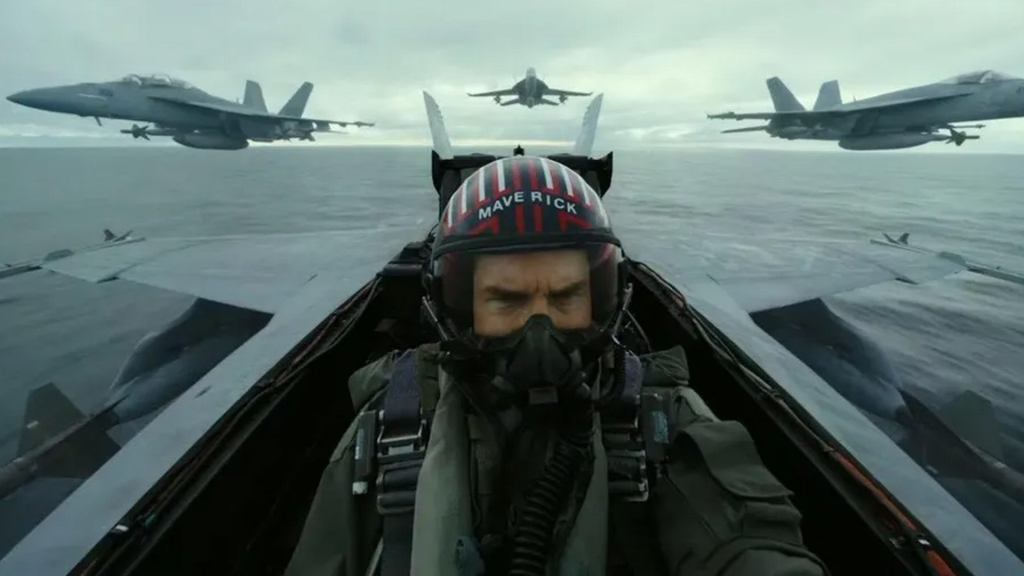
    The most arresting moments of Top Gun: Maverick come in the lengthy, spectacular aerial combat sequences, filmed practically with several IMAX cameras attached to the cockpit and nose of F-18 fighter jets that capture both the dazzling maneuvers flown by true elite Navy aviators as well as the genuine reactions and performances of the actors who are in the planes themselves and not acting in a green screen environment.

    Aerial combat has never felt as real and dynamic on screen as it does here, far surpassing the limitations of technology in the 1980s original film and creating a level of harrowing, yet magnetic cinema that viewers could easily watch several hours of regardless of a storyline.

    Hundreds of hours of footage captured by these Navy pilots both with the actors and through external jets following the action are meticulously edited into a crisp, supersonic freight train of exhilaration that will keep audiences on the edge of their seats and vault Top Gun: Maverick into contention for the year’s best film.

    Though there will likely only be room for one, perhaps two, early blockbusters come awards season, Top Gun: Maverick has the firepower cinematically to edge out The Batman and Everything Everywhere All At Once as the first half of the year hit to earn a Best Picture nomination and it’s all but certain to receive nods in editing, sound and best original song for Lady Gaga’s “Hold My Hand,” which plays over the end credits.

    Top Gun: Maverick has absolutely everything one might expect from a Cruise-led movie: Tom riding a motorcycle, Tom running at full speed, Tom grinning like he just stole something, everyone else around him in awe of Tom being Tom. Cruise’s magnetism and the dynamic thrills of the aerial artistry make this summer hit one of the best blockbuster films of the last 10 years and something cinephiles need to see in the biggest screen possible.

  • Everything Everywhere All At Once: Cinematic beauty in weirdness

    Everything Everywhere All At Once: Cinematic beauty in weirdness

    The directing duo of Dan Kwan and Daniel Scheinert, collectively known as Daniels, have created a brand of cinema flavored with creative ingenuity blended with the bizarre and outlandish that have seen them mystify viewers with flatulent corpses and dark humor with films like 2016’s Swiss Army Man and 2019’s The Death of Dick Long.

    Their third feature together, Everything Everywhere All At Once, takes their obsession with the absurd to new heights cinematically as the pair forge a strange, genre-bending tale that mixes Hong Kong martial arts with sci-fi hijinks, comic book universe hopping with family drama in a compelling, original film unlike anything audiences will see in 2022.

    Michelle Yeoh of Crouching Tiger, Hidden Dragon and Crazy Rich Asians fame stars as Evelyn, a down on her luck Chinese immigrant whose business is on the verge of collapse and her marriage on the brink of divorce. While heading to an IRS audit meeting, Evelyn is confronted by an alternate version of her husband, Waymond, who believes she is the only person capable of stopping the nefarious Jobu Tupaki from collapsing every possible universe.

    While the film could probably have been successful simply based on the Daniels’ creativity, Yeoh brings All At Once to the next level with a nuanced performance that is often frantic, sometimes melancholic, and ever transformative. She becomes a terrific stand-in for the audience as the film progresses with Yeoh’s initial confusion to the world Evelyn is forced into mirroring the bewilderment of viewers.

    As Evelyn grows in confidence and learns skills from alternate reality versions of herself, Yeoh is able to showcase her martial arts prowess and then immediately fall back into a stupor that is practical and convincing to Evelyn’s increasingly outlandish plight and as Evelyn comes to accept the ridiculousness of her situation, Yeoh makes it easier for audiences to suspend their disbelief as well and enjoy the ride.

    Yeoh is aided by a wonderful ensemble cast who must make even wider transformations between their character’s normal selves and bizarre variations.

    Ke Huy Quan returns to acting for his first role in two decades and steals nearly every scene he’s in as Evelyn’s sheepish, yet adorable husband Waymond. No matter what version of Waymond is in the moment – and all versions are incredible – Quan gives his whole heart to Waymond in a way that just leaps off the screen.

    Newcomer Stephanie Hsu is a revelation as the couple’s daughter Joy, a complicated blend of both her parents that allows Hsu to be more eccentric with her alternate versions and Jamie Lee Curtis is almost unrecognizable in a hilarious supporting turn as the IRS agent assigned to Evelyn’s audit.

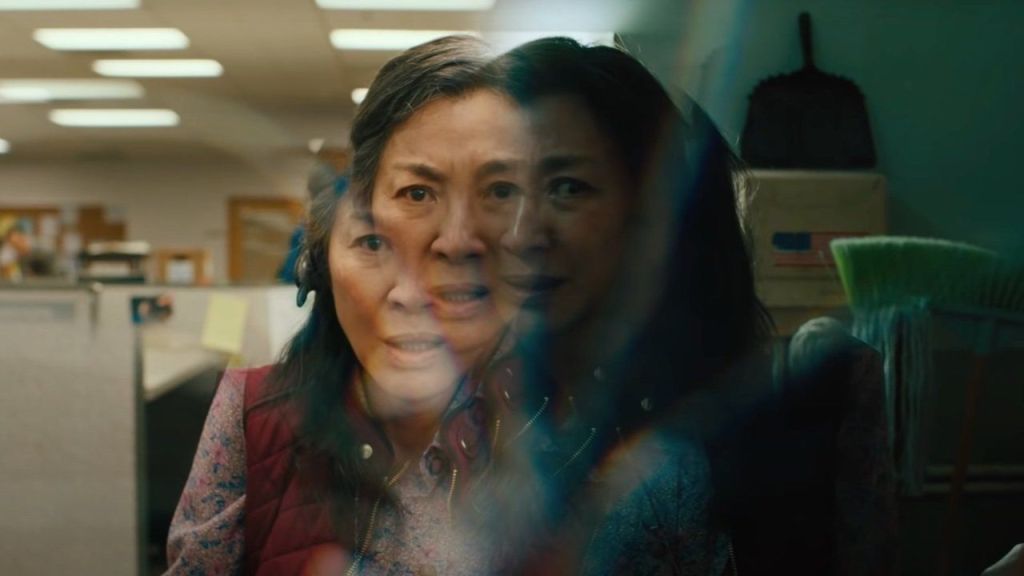
    All At Once is even more spectacular in terms of its visual effects, which was developed by a team of only five to create over 500 different shots in the film. Daniels use both practical and computer-generated effects to showcase Evelyn’s bridge between the versions of herself, dubbed “verse jumping” in the movie, and the look of Yeoh rapidly falling backwards is a constant blur of motion and imagery that keeps viewers at the edge of their seats.

    The film also moves at an intensely rapid pace thanks to distinct and swift editing by Paul Rogers that makes the most of the dynamic action sequences that perfectly blend martial arts with the strange science fiction elements of the plot.

    Daniels also create a fully realized, wholly immersive world with some of the best production design and costuming that will probably be featured in all of 2022. The depth to which the filmmakers transform a simple office building into a plethora of avenues for creativity cinematically is astonishing and the costume work, especially on Curtis’s Deirdre and also Jobu Topaki showcase the avantgarde uniqueness and originality unmatched in this era.

    Because All At Once is so outside the box – there’s literally worlds with hot dog hands and pinatas – it’s unclear how a film released in the first half of the year will stay in the conversation long enough to earn the awards season acclaim it deserves, but Daniels’ film definitely deserves to stand alongside The Batman as the two features to release before July that need to be remembered by voters months from now.

    Though it will be a fun experience at home for audiences who can’t find it close to them, there’s no doubt that the visual thrill ride of Everything Everywhere All At Once deserves a trip to the cinema to see the Daniels’ vision on the biggest screen possible and this strange, yet heartfelt will no doubt be a top film of the year.

  • CODA: Winning with heart

    CODA: Winning with heart

    Fourteen months ago, a small independent film with a largely unknown cast and an Oscar winner in a smaller supporting role debuted to critical acclaim at the Sundance Film Festival, winning top prizes and a hefty payday from Apple.

    The grand jury prize winner was expected to help launch the second wave of subscriptions to AppleTV+, a burgeoning streaming service fighting an uphill battle with stalwarts like Netflix, Amazon and Hulu for viewership.

    Critical success continued when CODA, director Sian Heder’s heartwarming family coming-of-age dramedy, arrived on the streamer last August, but didn’t seem to draw attention in the same way from casual audiences.

    Now there’s not really an excuse for ardent cinephiles to miss CODA despite being exclusive to a secondary streamer as the film took home three Academy Awards including Best Picture Sunday evening during a very congested ceremony that may continue to overshadow this smaller feature.

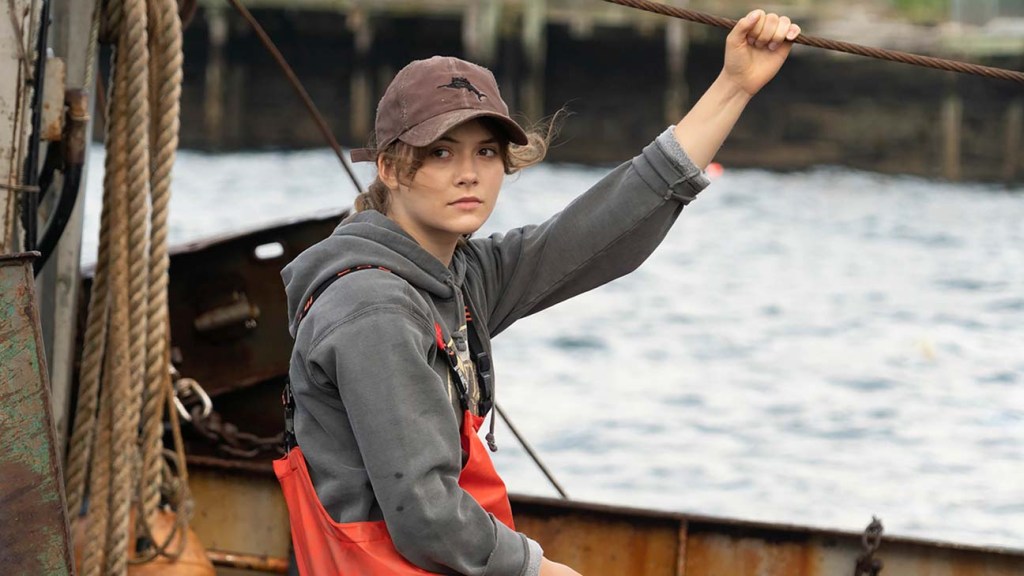
    Adapted from the 2014 French film La Famille Bélier, Heder’s drama stars Emilia Jones as Ruby, a CODA or “child of deaf adults,” who longs to pursue her passion in music but fears abandoning her parents as the family’s fishing business is threatened.

    It’s the first feature film to debut at Sundance and go on to win Best Picture, and in large part, the underdog win can largely be attributed to the film’s terrific cast of predominantly deaf/non-hearing members that provide the humor, heart, and passion of CODA.

    Troy Kotsur rightly earned his Best Supporting Actor Oscar with a truly layered turn as Ruby’s father Frank, who wonderfully portrays anger and frustration over struggles with the business in one scene and can effortlessly wash that all away to carry the film’s funniest moments as one-half of an awkward parental unit with Marlee Matlin.

    Kotsur’s Oscar moment late in the film in a scene opposite Jones where the two are able to bond over music despite their hearing differences certainly propelled CODA to its win and it’s a genuinely heartwarming moment.

    Jones also has terrific chemistry with Daniel Durant, who plays Ruby’s brother Leo, and it’s Durant’s brash attitude in being the overlooked older brother that helps solidify the terrific family drama.

    CODA suffers somewhat from attempting to bridge together two separate films into one and the quality balance doesn’t quite matchup between the two, which makes its Best Adapted Screenplay win somewhat befuddling. Perhaps voters keyed in on the 40 percent of the script in American Sign Language, which held most of the emotional moments that pulled on voters’ heartstrings.

    The core of the film, where Heder really shines, is in the family drama with Ruby’s struggles to become her own person outside of interpreting for her father and brother for their fishing business. When CODA leans on its deaf cast members, the film is engaging, unique and poignant.

    There’s a secondary storyline that runs largely parallel to the family dynamic that doesn’t particularly mesh well until the final moments of the film. Ruby’s love of singing and involvement with her school choir often feels like an overextended episode of Glee, which is referenced in the movie. Giving this plotline equal weight in the running time – especially with an unneeded love interest – makes CODA artificially long at nearly two hours and separates viewers from the best parts of the film.

    Winning Best Picture gives CODA the higher profile needed to draw audiences in who otherwise would never make an effort to seek it out. But it’s disappointing to see films with greater technical merit and artistic vision not rewarded more for their boldness and risk-taking.

    CODA is far from an unworthy winner and its warmth, heart and uplifting narrative make it the crowd-pleaser that any cinephile would enjoy on a casual Friday night at home.

  • Nightmare Alley: Beautiful noir for small crowd

    Nightmare Alley: Beautiful noir for small crowd

    Acclaimed auteur Guillermo del Toro hasn’t made a new film since winning both best director and best picture in 2018 for his eccentric feature The Shape of Water.

    del Toro is known as a master of the avantgarde, relishing in the eccentricities of life and the oddities of horror for decades with everything from Pan’s Labyrinth to a pair of Hellboy films to an upcoming adaptation of Pinocchio for Netflix.

    His latest film, Nightmare Alley, taps into del Toro’s love for the obscure and bizarre, all the while emphasizing the uniqueness of a period piece that twists and bends what the mind might find conceivable.

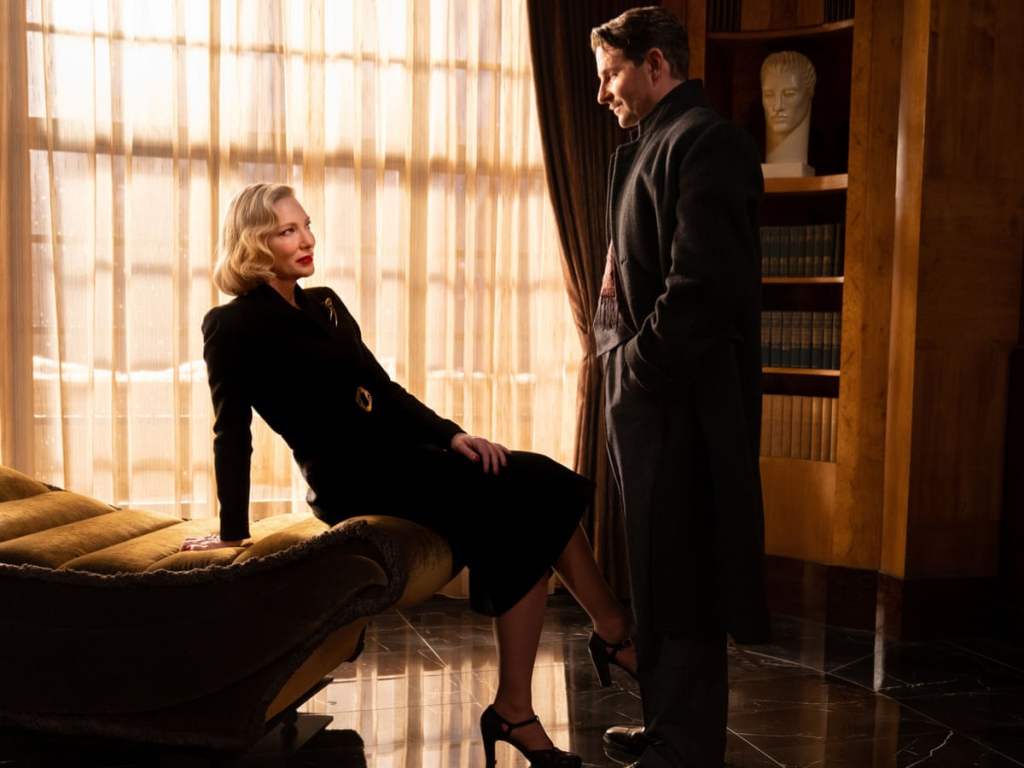
    Based on both the 1946 novel and 1947 film of the same name, Nightmare Alley follows Stanton Carlisle, a man who joins the circus leading up to World War II after murdering a man and burning down his house. When he learns the art of mentalism from a “clairvoyant” couple, he sets off on his own for fortune that ultimately leads down a dark path. 

    Bradley Cooper provides a mostly stoic yet measured performance as Stanton and it’s a turn that helps ground the audience in the story without endearing them too much to his questionable choices. 

    While his chemistry with Rooney Mara’s Molly is somewhat shaky despite the plot’s desire to pair them, his ability to match Cate Blanchett’s mysteriously alluring Dr. Ritter makes for a scintillating repartee that anchors the back half of the film. 

    Nightmare Alley has an incredibly deep and talented supporting cast from David Strathairn and Toni Collette’s masterful work as the clairvoyants to Willam Dafoe’s circus leader to Richard Jenkins perfectly playing against type as a rich and nefarious widower. 

    del Toro’s film is a visual cavalcade of everything that makes del Toro one of the world’s premiere filmmakers. There’s so much depth to each scene with elaborate production design and set dressing creating a world in every location. 

    Cinematographer Dan Lausten creates a wide, expansive arena for cinematic beauty in every frame, longing for audiences to linger in the haunting complexities of del Toro’s vision. No matter what the camera is focused on, each character and set piece is framed and lit in such a way that demonstrably makes it feel like the most important moment in the entire film, which is an astounding feat for a feature littered with unforgettable imagery.

    At a running time of 150 minutes, Nightmare Alley somewhat languishes out of the gate as del Toro deeply and richly builds the world of his film to the detriment of pacing. Once Stanton strikes out on his own, however, Nightmare Alley picks up considerably and becomes an exceptionally compelling noir. 

    The issue truly stems from del Toro’s insistence on creating a backdrop for Cooper and the rest of the cast to revel in. There isn’t much to define the story outside of the technical aspects for most of the first hour and many viewers may decide to opt out of the film altogether before things fully come to fruition.

    As a result, Nightmare Alley is unlikely to receive any major acclaim come Oscars season, although it could do well in below-the-line categories like production design, cinematography and costuming. 

    While it might behoove ardent cinephiles to seek out specialty screenings of the film in its new limited black-and-white release, casual viewers might be more willing to take a chance on Nightmare Alley now that it has become easily accessible on Hulu and HBO Max. The vision of del Toro combined with masterful technical elements and compelling, yet somewhat thin performances make Nightmare Alley something worth taking a chance on via streaming service that they wouldn’t normally drive to a theater to see.